Every post is a test. This is inherent when discussing YouTube videos and paid ads, where A/B testing is built directly into the content distribution system, but the same logic governs organic distribution. Recommendation systems continuously test content against different audiences, evaluate behavioral responses, and decide whether distribution should expand. On TikTok, videos move through recommendation waves. On LinkedIn, content is introduced to portions of your network before relevance signals determine broader circulation. Across platforms, visibility emerges through testing.
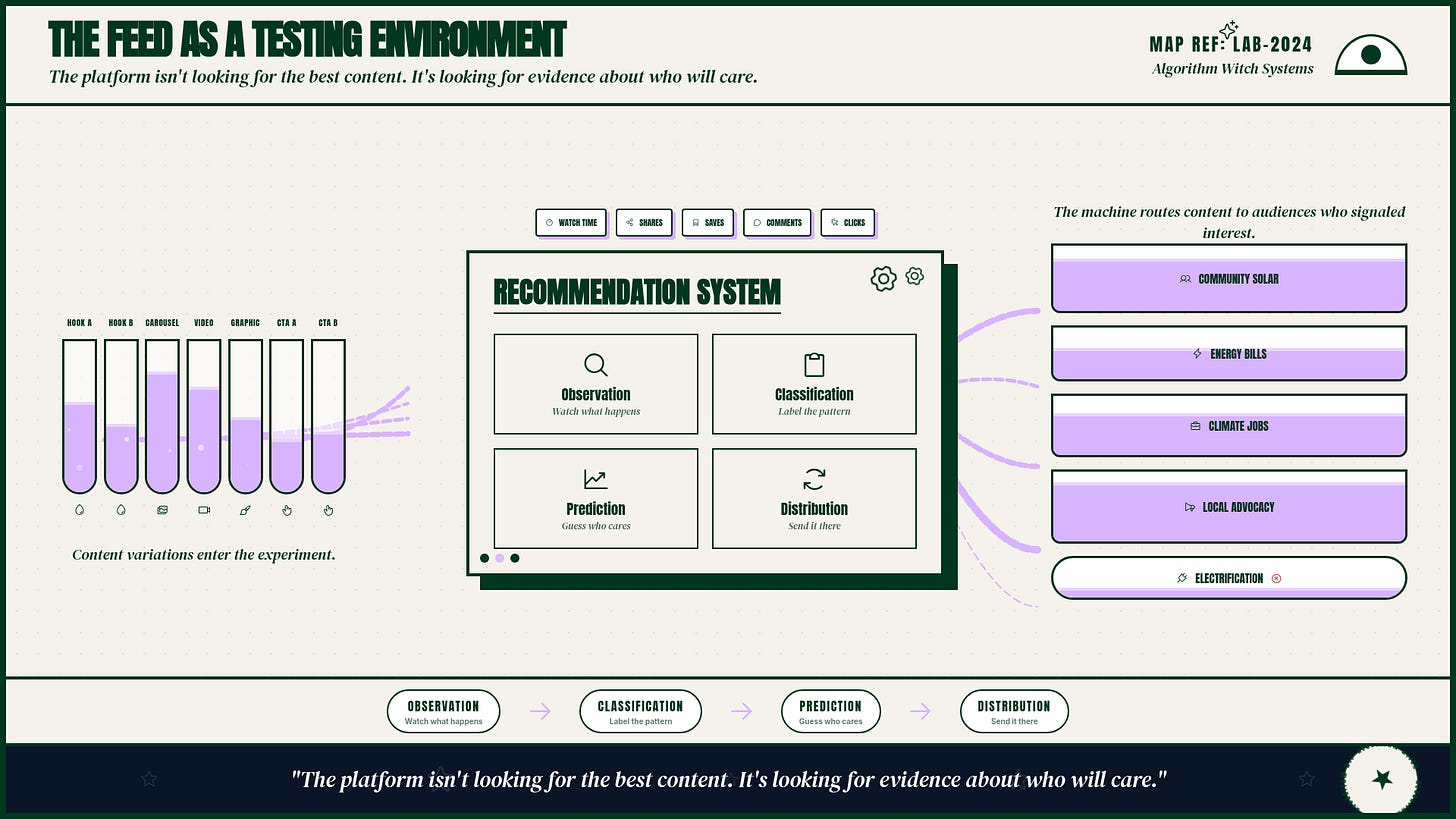
Organizations can feel trapped by social media platforms if they are searching for a perfect formula. In reality the feed behaves more like a series of tests and trials. Platforms introduce content to small groups, observe what happens, and use those observations to determine what happens next. Consistency matters because classification requires repeated observations. Experimentation matters because distribution requires evidence. When thousands of posts compete for the same finite resource, recommendation systems rely more heavily on predictive models to determine which experiments deserve additional exposure. Clarity becomes a classification advantage because clear signals are easier to measure. Organizations that test systematically create cleaner data, making it easier for recommendation systems to identify patterns and route content toward the right audiences.
For climate, clean energy, and advocacy organizations, this changes how communications should be evaluated. A single post about utility affordability, community solar, or weather resilience produces one observation. Twenty posts exploring different angles, formats, and calls-to-action begin revealing how people recognize themselves within an issue. Testing becomes a form of audience research happening in public. Every post generates information. Every response becomes data. Every interaction contributes another result to the experiment.
01What Paid Advertising Teaches Us
Ads across Google, LinkedIn, YouTube, TikTok, and Meta make testing accessible by exposing performance data directly and building experimentation into the campaign process itself.
Advertisers routinely test headlines, images, audiences, landing pages, thumbnails, titles, and offers. Nobody expects the first ad to be perfect because nobody expects to know exactly how an audience will respond before the campaign begins. Performance emerges through iteration. Organic social works the same way, except the mechanisms are less accessible.
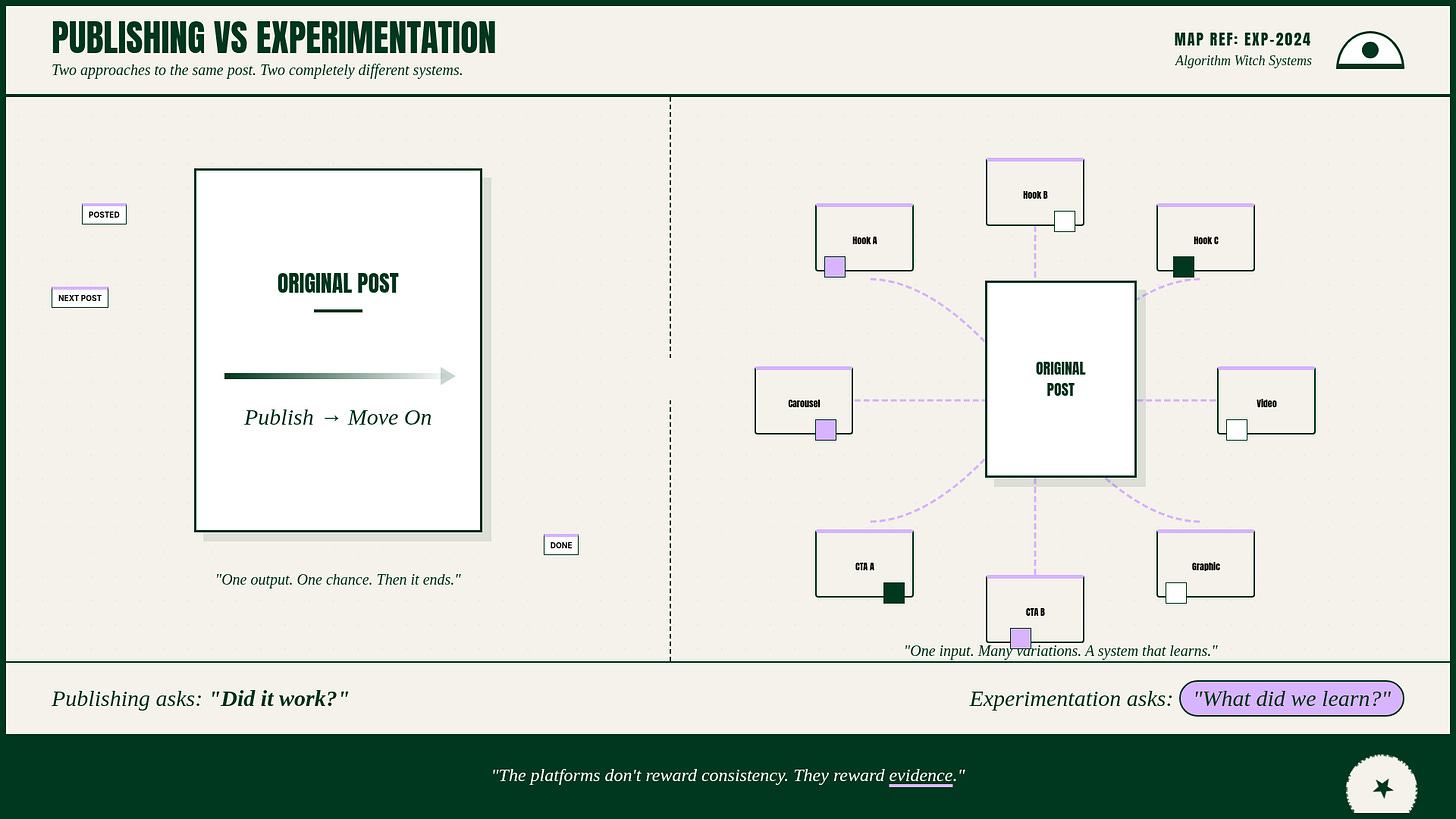
Stop looking at organic posting as publishing and instead think of it as experimentation. Don’t publish a post and move on. Use that data: evaluate the result, publish multiple variations, and expect uncertainty.
Recommendation systems operate under uncertainty. Platforms do not know the right audience in advance. They begin with a small sample, observe what happens, and use those observations to determine additional distribution. The process is literally an experiment. Changes to a hook, call-to-action, or thumbnail all generate new information about audience behavior. Some experiments produce stronger signals. Others reveal dead ends. Both outcomes are useful because both reduce uncertainty.
For climate, clean energy, and advocacy organizations, this changes how communication strategies should be evaluated. A post about community solar that receives little engagement is not necessarily evidence that people do not care about community solar. It may reveal something about the framing, the format, the audience, the timing, translation, or the pathway for participation.
This is how advertisers think, and increasingly how organizations need to think as well. Evaluate campaigns through collections of tests rather than individual posts. Test formats, hooks, audiences, calls-to-action, and participation pathways. Expect uncertainty and recognize that visibility emerges from accumulated evidence rather than isolated success.
There are countless experiments worth running. To make this practical, we will look at 3 experiments you can start this week.
02🧪 Experiment 1: Calls-to-Action
A call-to-action is the next step you want someone to take after engaging with your content. If every post ends with the same call-to-action, you are only testing one pathway into the work.
A strong CTA usually contains three things:
An action people can take.
A result or outcome they can expect.
Direct language that helps them see themselves in the action.
For example:
Download your clean energy guide.
Find your next climate job.
Register for your local webinar.
Join our community.
Share this with someone in your network.
Notice that each CTA contains a verb and a destination. The reader knows what action they are taking and where that action leads. Research has also found that second-person language such as “you” and “your” can increase involvement because people are more likely to mentally connect themselves to the message.
To run this experiment, keep the content itself relatively consistent and change only the call-to-action.
A climate jobs newsletter might test:
Find your next climate job.
Subscribe for weekly opportunities.
Share with someone job searching.
Join the community.
A solar nonprofit might test:
Download your solar guide.
Calculate your savings.
Attend the webinar.
Contact our team.
A policy organization might test:
Read the report.
Sign up for updates.
Contact your representative.
Attend the town hall.
Track what happens next. Which CTA generated clicks? Which generated signups? Which generated meaningful participation? Each CTA creates a different participation pathway. Your goal is to understand which pathways will drive your target audience to your targeted action.
03🧪 Experiment 2: Hooks in Short-Form Video
A hook is the opening that introduces the content. Hooks can be visual, verbal, environmental, emotional, or structural. It creates the audience’s first impression and determines whether they continue watching.
To run this experiment, keep the topic relatively consistent and change only the hook.
Imagine a nonprofit promoting community solar.
The first video opens with bold on-screen text:
"YOUR ELECTRIC BILL IS ABOUT TO CHANGE"
The second opens with someone speaking directly to camera in their kitchen:
"I didn’t realize I could access solar without owning a roof."
The third opens with a controversial statement:
"Most utility companies don’t want you thinking about this."
The information may be nearly identical, but the entry point changes. A useful way to structure hook testing is to create three versions of the same topic:
A visual hook.
A relatable hook.
A controversial hook.
A visual hook might use:
Large text on screen.
An unusual camera angle.
A surprising image.
Motion before explanation begins.
A relatable hook might use:
A casual environment.
A personal observation.
A familiar frustration.
An everyday experience.
A controversial hook might use:
A challenge to conventional wisdom.
A misconception.
A surprising claim.
A statement people feel compelled to evaluate.
For example, a climate organization discussing extreme heat could test:
Visual: Thermal map footage showing neighborhood temperature differences.
Relatable: “My apartment was 90 degrees before noon.”
Controversial: “Some neighborhoods are designed to be hotter than others.”
Track what happens next. Which version generated the highest watch time? Which version generated comments? Which version generated shares? Which version led people to continue engaging with the topic?
The goal is not identifying the universally best hook. The goal is understanding which entry points create recognition for your audience. Different audiences respond to different signals. Testing helps reveal where attention begins and what conditions encourage people to continue participating in the conversation.
04🧪 Experiment 3: Formats
A format is the structure used to deliver information. The same idea can become a video, a carousel, a graphic, a link, a blog post, or newsletter. While the information remains the same, each format creates different behavioral opportunities and different ways for audiences to engage.
To run this experiment, keep the topic relatively consistent and change only the format.
Imagine a clean energy organization explaining home electrification rebates.
Create three versions of the same content:
A link social card
A carousel.
A short-form video.
The social card could highlight a takeaway while the carousel can break the process into multiple steps and provide additional context. The video could walk viewers through the information while adding narration, visuals, and movement. The format changes.
Different formats create different behavioral opportunities:
Link social cards drive clicks.
Carousels create swipes, saves, and repeat visits.
Videos create watch time and completion rates.
Newsletters create direct relationships with audiences.
For example, a climate organization discussing extreme heat could test:
A social card with a link to an extreme heat report.
A carousel explaining urban heat islands.
A short-form video showing thermal imagery.
A long-form video connecting heat to housing, infrastructure, and public health.
Track what happens next. Which format generated saves? Which generated shares? Which kept people engaged longest? Which drove traffic to your website? Which generated participation?
Your goal is understanding how your audience prefers to receive information. A common mistake is assuming poor performance means people are uninterested in an issue. But sometimes the issue is the format. Testing formats helps reveal how information travels, how people engage with it, and where participation becomes possible.
05Finding a Strategy That Works
Testing breaks you out of the chase for virality by giving you a strategy and approach for understanding and achieving your measurement of success.
Once you have established your priorities for conversion you may find that a post that reaches 100 people generates more participation than a post that reaches 100,000. Testing shifts attention away from individual outcomes and toward patterns for long-term success. Over time those patterns reveal how audiences recognize an issue, which formats create engagement, which calls-to-action generate participation, and which ideas continue traveling across platforms.
When the same audience consistently saves your carousels, replies to your commentary, watches your videos through completion, or clicks a specific type of resource, a pattern begins to emerge. The recommendation system learns what your content represents. Your audience learns what to expect. Recognition becomes easier. Distribution becomes more stable. Your strategy is a collection of your best experimental results.
Act like a media organization: publish, observe, adjust, and publish again. Each post generates information. Each format reveals behavior. Each CTA tests participation. The feed is a research environment where audiences continuously show you how they want to enter the work. And because platforms distribute content through behavioral signals, semantic clarity, and predicted relevance, every experiment improves classification at the same time it improves understanding. The organizations willing to build in public create stronger signals, stronger participation pathways, and vetted infrastructure for visibility.