Walking along a crowded beach and looking out across at the waves, each one looks a little different. Some waves arrive or break earlier. Some carry more foam. But after a while the waves begin to blur together because they’re all being shaped by the same shoreline, the same currents, and the same conditions underneath the surface.
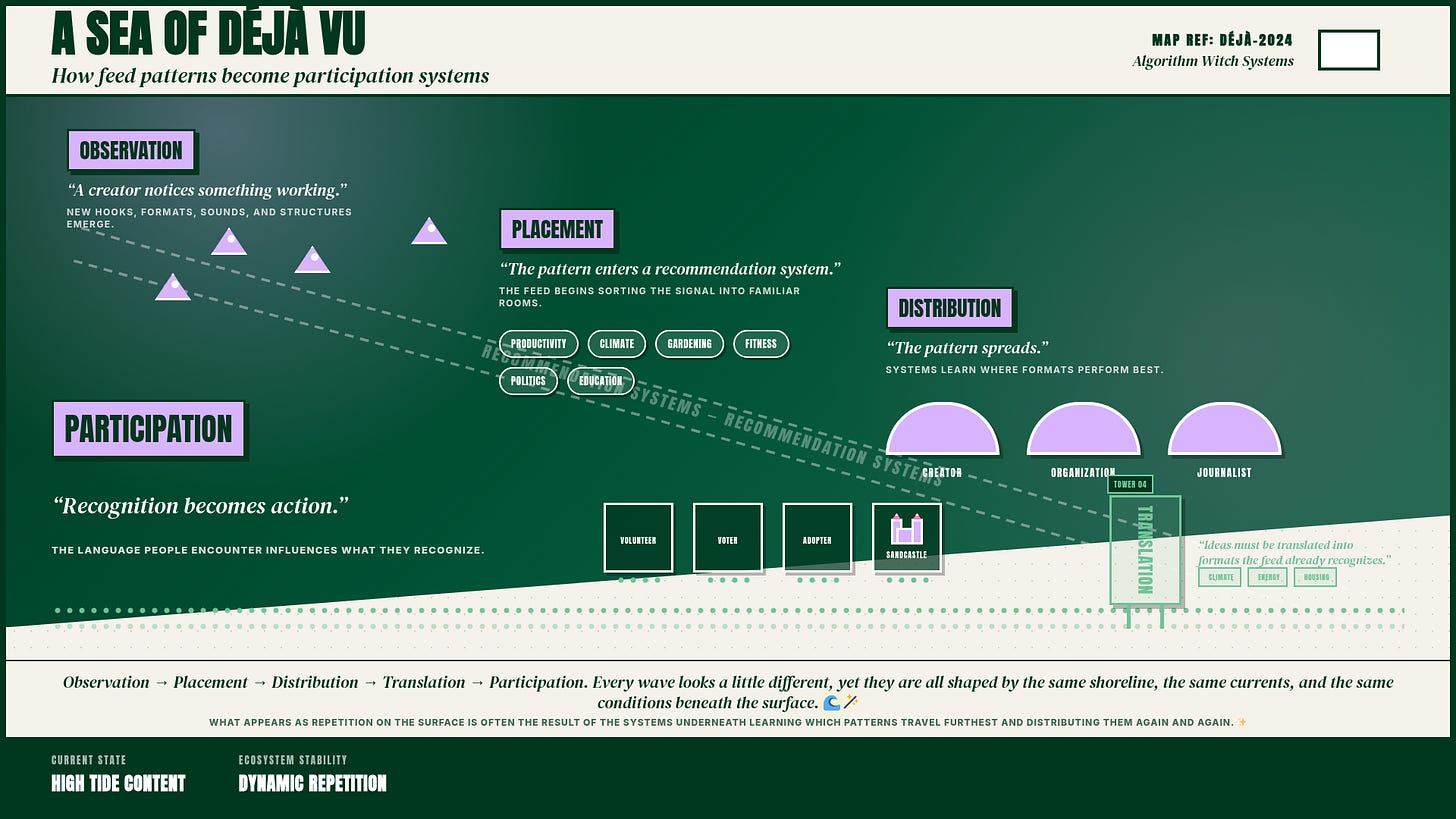
The repetition people notice in their feeds is a natural result born from the trend ecosystem. I like to think about this ecosystem in 5 stages: observation, placement, distribution, translation, and participation.
First, an observation, a creator notices a format performing well. Perhaps not at the level of a trend yet. As a hook, design, sound, or phrase. The platform notices engagement increasing, the observation might evolve into a trend or stay within a specific niche. The audience recognizes the system and is primed for receiving information in the format they recognize.
These observations are how we create the language of the feed and it’s the job of digital strategists to translate the work of organizations into this language. Observations, and in their strongest form: trends, become a shared lexicon for ideas to be disseminated across the feed.
Second, placement occurs when the observation earns a place inside a system. Placement is why you watch one video of a cat pushing things off a table, and then see 5 more in your feed. The terms “doomscroll,” “brainrot,” and “AI slop,” all describe the monotony of the feed and how recommendation engines can over-classify and in some was misclassify audiences to the point that the content they consume is not aligned with their interests and more aligned with behavior patterns that the platforms themselves may be incentivized to create. Recommendation engines have classified the format, placed it in the feed, and distribute it to audiences that watch similar content.
The third stage, distribution, determines how widely the pattern spreads. The more the pattern is engaged across interests, the more often people encounter it. Distribution requires appealing across interests to drive engagement while also being clearly classified by recommendation systems.
Over time translation is more and more essential and the job of digital strategists is to bridge the translation gap. “Observations” without translation continue moving efficiently through feeds while the purpose behind it becomes harder to distinguish. Visibility can seem strong because the structure is recognizable, yet variation and therefore participation becomes increasingly difficult because recommendation systems have learned to reward the pattern itself rather than an end result outside the system.
Visibility eventually shapes participation. The language people encounter influences what they recognize, recognition influences whether they see themselves inside a topic, and participation determines who ultimately enters the conversation. Climate organizations, nonprofits, companies, researchers, journalists, and creators all depend on the same recommendation systems. Understanding why feeds become repetitive helps explain how ideas spread and how to build participation across digital environments.
01How do Recommendation Systems Work?
People do not suddenly gain three extra hours of scrolling each day because more content exists, so feeds operate inside fixed attention budgets. Recommendation systems must sort a growing volume of content into the same amount of available attention. This dynamic already appears across visibility systems where content supply continues growing faster than audience attention.
As more content enters the system, platforms become increasingly dependent on prediction. Recommendation systems must determine what content is about, which audiences might care about it, how likely engagement becomes, and whether distribution should expand further. Classification becomes infrastructure because it allows platforms to organize far more content than human review could ever process.
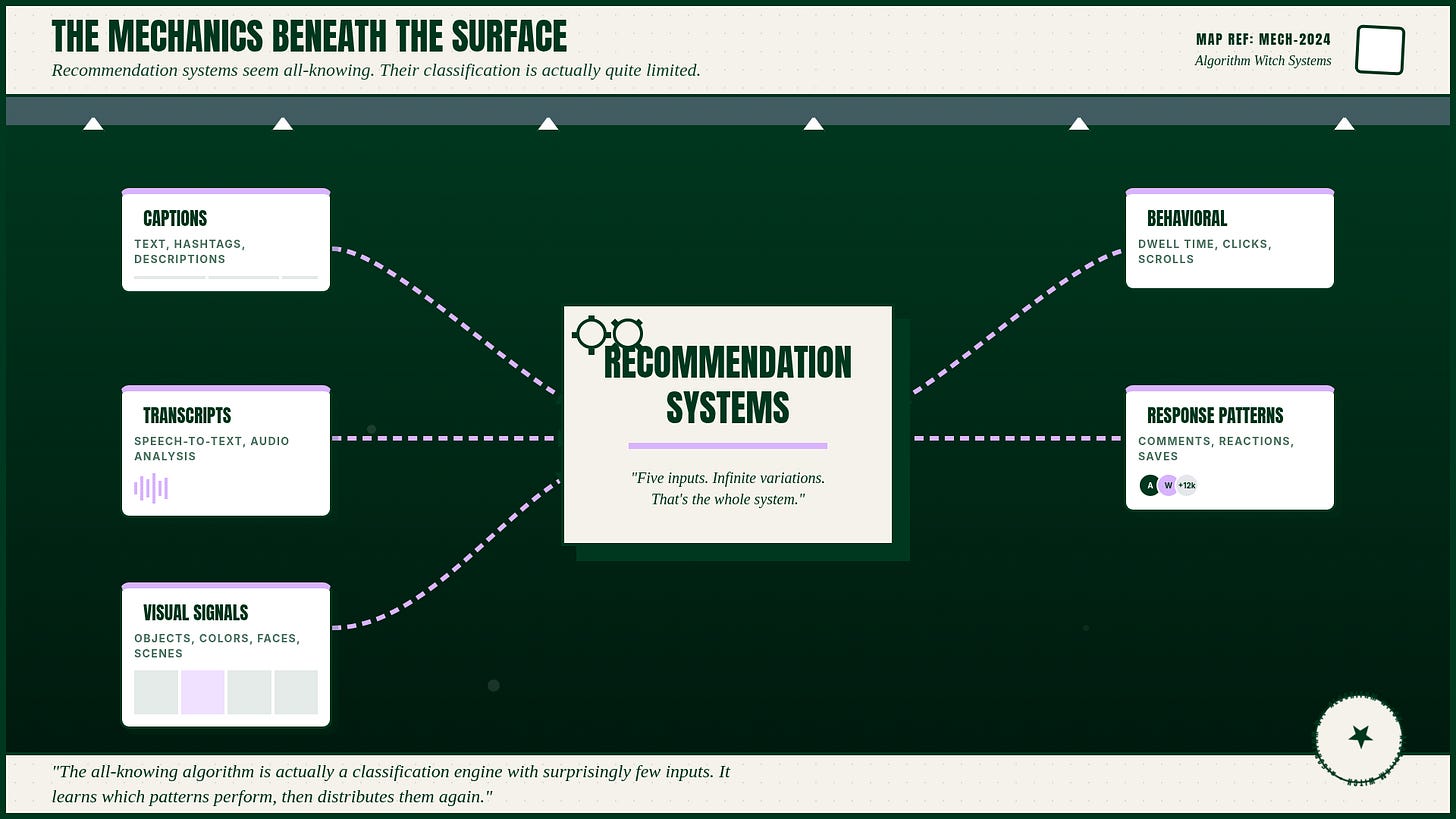
As more creators publish, recommendation systems must become more selective. Platforms increasingly depend on predictive models to determine:
what a piece of content is
who might care about it
how likely someone is to engage
whether distribution should expand
Classification becomes more important because platforms cannot manually evaluate billions of posts. The feed becomes crowded long before it becomes diverse. More content enters the system, yet much of it competes around similar topics, structures, and audience expectations.
02Classification Rewards Familiarity
Recommendation systems do not understand creativity the way humans do. When creators discover patterns that work, those patterns spread quickly. You can start recognizing these patterns by paying specific attention to hooks, design/effects, sounds, and language/voice
Recommendation systems seem all knowing, but have comparatively limited classification. It’s usually done through a mix of:
captions
transcripts
visual signals
behavioral signals
audience response patterns
Better algorithms have more accessible data feeding their recommendation system. This is somewhat comparable to search engine optimization. Classification systems perform best when categories are clear. Categories exist across platforms from the perspective of the recommendation engines. Some common categories for climate are news, lifestyle, and education. I would recommend taking a look at your past content to try and determine what classification your content currently has on especially Instagram, TikTok, and Youtube. Then for 3 months, testing content outside of that classification to see if you can expand your audience by reaching new viewers. This also ties to my theory that climate should be inextricable from day to day life. If climate, clean energy, and advocacy are being classified across all categories then there would be no one online we couldn’t reach. And I fully believe that the nature of climate work is embedded in every aspect of daily life, so in a sense this is light work.
Classification becomes infrastructure and creators adapt accordingly. We repeat themes because themes strengthen classification. We repeat language because language strengthens classification. We repeat formats because formats strengthen classification. Over time, language starts functioning as metadata. Formats start functioning as metadata. Visual identities start functioning as metadata.
03The Repeat Format Strategy
Creators test formats, topics, lengths, visual styles, and structures until something gains traction. Once a format succeeds, the rational decision is often repetition. The format already proved it can travel.
Over time, successful formats spread across the ecosystem because creators are constantly observing each other. A structure performs well for one creator, then dozens adopt it, then hundreds adopt it, and eventually the format itself becomes recognizable independent of the people using it. What began as experimentation becomes infrastructure.
The format continues producing visibility because it aligns with recommendation incentives. The creator often wants to continue exploring new ideas because curiosity, expertise, and growth depend upon variation. Visibility and development begin serving different functions.
The tension many creators describe is between creativity and consistency. It is a tension between the systems that help content travel and the systems that help ideas evolve.
Creators describe feeling trapped by successful formats because audiences begin expecting familiar structures while recommendation systems continue rewarding them. The content performs, but the work can start feeling increasingly disconnected from curiosity, experimentation, or growth.
This creates a strange outcome where visibility increases while creative flexibility decreases. The same few climate video structures, nonprofit storytelling approaches, infographic formats, and educational content patterns increasingly dominate distribution because they have already demonstrated their ability to travel. In this case, I also recommend testing content. If you know one format performs well and you can’t afford to see engagement fluctuate, just test one new post a week to see if you can expand to new audiences.
04Build it & They Will Come
The waves are similar because they responding to the conditions of the ocean. The future probably contains more content, more classification, and more prediction. What becomes valuable is understanding the conditions underneath those systems and creating infrastructure that allows new ideas, perspectives, and participants to emerge even as recommendation systems continue rewarding familiarity. The challenge is separating the systems that serve distribution from the systems that serve development.
As more organizations converge around the same structures, fewer entry points remain available for audiences who do not immediately recognize themselves in those formats. Optimization can narrow participation if every organization communicates through the same structures. Movements depend on bringing new people into conversations. If visibility systems repeatedly amplify familiar formats, audiences may encounter fewer entry points into complex issues, making recognition and participation more dependent on existing platform norms than community needs. This challenge extends beyond content performance. Climate and advocacy work depend on helping new people locate themselves inside an issue and how to take action. When visibility systems repeatedly amplify the same communication structures, recognition increasingly depends on platform conventions rather than community experience.
Creators can then continue publishing the formats that audiences recognize while deliberately testing one or two new structures each week. Some experiments fail. Some eventually become the next repeatable format. The process creates enough stability for recommendation systems to maintain classification confidence while preserving enough variation for new ideas to emerge and new ways for audiences to participate to be born. The key is to continue testing and analyzing the conversions you do have to see what strategies drive the results you want.
Organizations and creators can maintain recognizable signals for recommendation systems while continuing to develop new ideas outside the constraints of feed optimization. The feed can continue distributing familiar formats while long-form environments continue generating new perspectives, new frameworks, and new experiments.