I bet you celebrate Earth Day. But what about National Park Week? Energy Awareness Month? Black Climate Week? If you’re part of a climate organization chances are you’ve celebrated at least one of these or maybe even all four.
For years, climate organizations communicated through a shared watershed of attention. Awareness months, elections, policy fights, media coverage, and public campaigns fed into larger currents that carried information across communities. Organizations could step into those currents and direct people toward reports, petitions, events, and opportunities for action. The value of these moments was the flow. Attention sprang and flowed downstream through networks that many organizations shared.
Climate communication grew within that environment. A report could enter a larger conversation already in motion. A petition could connect to a public debate that audiences, journalists, and institutions were already following. Participation traveled along channels built by governments, media organizations, platforms, and civic institutions. Much of the infrastructure that carried attention existed before an organization ever published a single post.
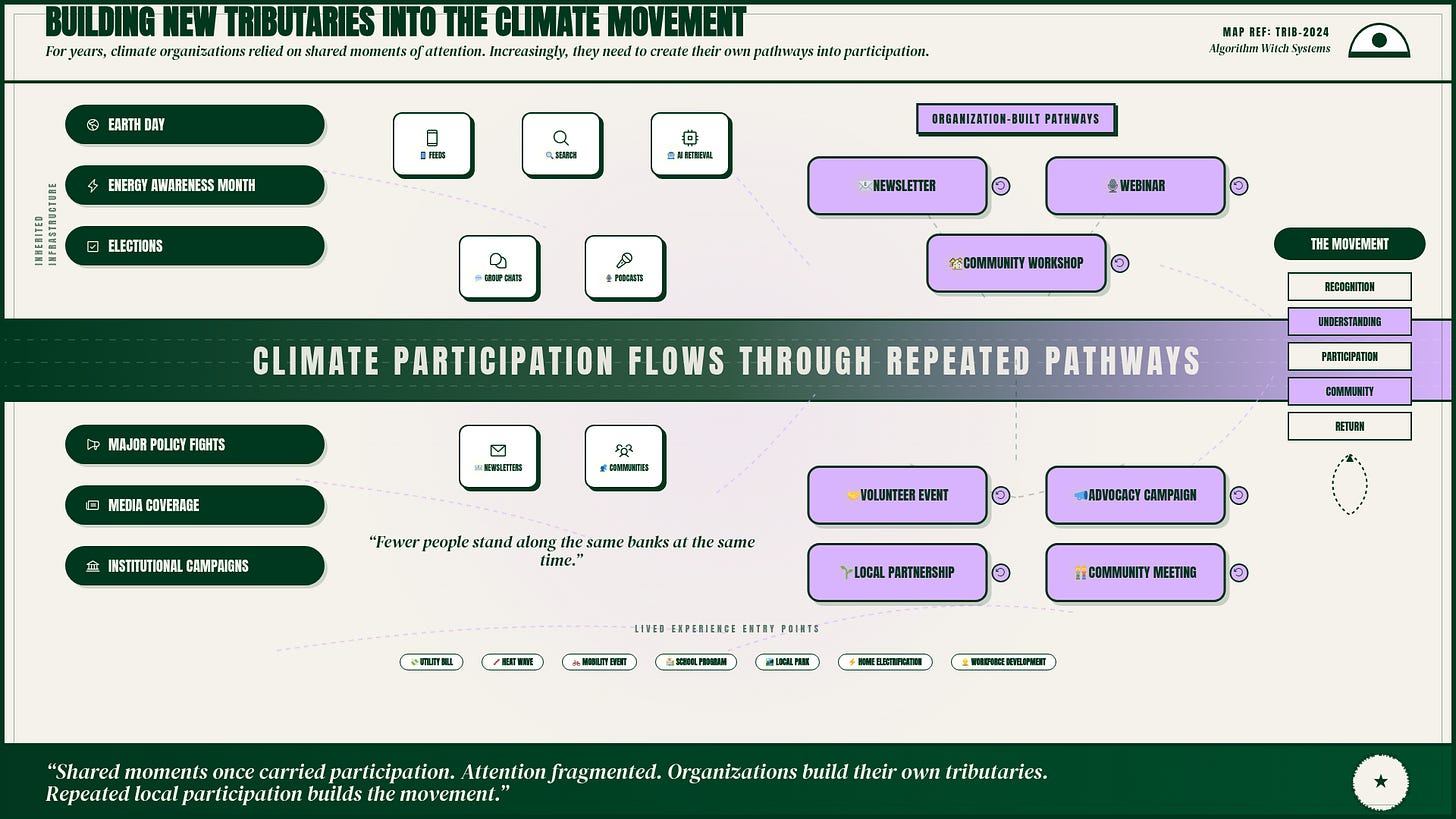
Today that watershed looks different. Attention still moves, yet it travels through a growing network of streams, tributaries, and reservoirs. Feeds personalize information. Search increasingly routes through AI retrieval systems. Communities gather around long-form content, newsletters, podcasts, creators, group chats, and niche platforms. Fewer people stand along the same banks at the same time, which means fewer organizations can rely on existing currents to carry their work downstream.
As the watershed fragments, organizations increasingly need to shape their own channels. A recognizable brand becomes a landmark people can return to. A newsletter becomes a recurring current. A podcast becomes a gathering place. A webinar series becomes part of a community’s seasonal rhythm. Climate organizations are being forced to become media systems because participation directly depends on creating places where people can repeatedly encounter the work, recognize themselves within it, and participate by taking action. The organizations building those systems are creating the waterways through which participation flows.
01Campaign Logic Meets Platform Logic
Many climate organizations are structured around calendars they inherited. Governments, nonprofits, schools, international institutions, and community organizations have invested in recurring environmental observances that create moments for public participation. Earth Day became a global event because institutions continuously organized around it, creating a shared rhythm that helped people connect environmental issues to their communities.
Those rhythms depend on institutions willing to sustain them. In 2026, government support for environmental participation appears far less certain than it did only a few years ago. These moments create opportunities for coordination that would be difficult for any single organization to build alone. They concentrate attention around a shared set of issues and create pathways into participation. Yet environmental issues have always been experienced locally, and the institutions that once helped concentrate attention around those moments no longer carry the same influence they once did. As attention spreads across platforms, communities, and information systems, organizations increasingly need calendars that reflect local conditions alongside the larger observances they inherit. Environmental observances remain valuable, yet organizations can no longer assume public institutions will create the same volume of participation opportunities or even visibility around them.
The strongest climate and clean energy campaigns build participation infrastructure between those moments. Connect Earth Day to a volunteer event, a newsletter to a local workshop, or a policy campaign to a community meeting, creating clear pathways from awareness to action. Set goals and track how many people your team wants to reach, engage, and ultimately convert into participants. By creating recurring opportunities for people to mobilize and take action, your team will avoid relying entirely on a handful of shared observances by building your own tributaries that connect local action to larger movements.
Local rhythms create continuity. Your audiences return because there is another event, another conversation, another opportunity to participate. Over time, those repeated points of entry become part of the watershed itself, creating pathways that allow communities to remain connected to environmental work long after a single campaign or awareness day has passed.
02From Observance to Participation
Consider National Energy Awareness Month in October, established by the Department of Energy in 1991. A traditional communications approach might publish a blog post, send an email, host an event, and move on. The observance creates a moment of attention, yet much of that attention disappears once the month ends.
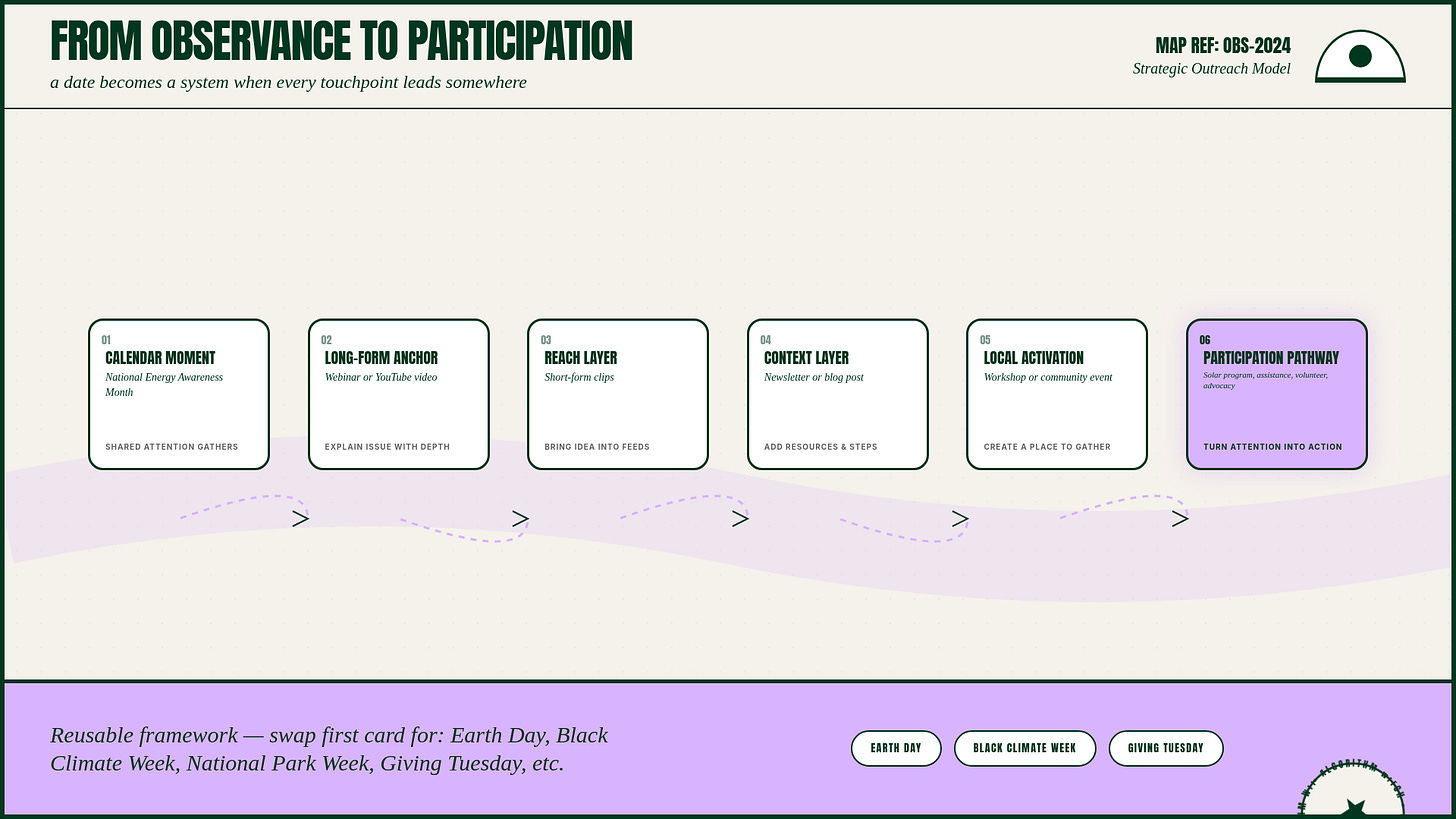
A media system treats the same moment as the beginning of a journey. A webinar on energy efficiency introduces the issue. Short-form videos expand its reach. A newsletter provides additional context and resources. Local workshops create opportunities for conversation and learning. Community solar programs, energy assistance resources, volunteer opportunities, and advocacy campaigns provide clear pathways for action.
Media systems create more opportunities for people to enter the work. A single observance becomes a network of connected experiences that help someone progress from awareness to participation. What started as a date on a calendar becomes a system that continues creating value long after the observance itself has passed.
03The Website Becomes the Watershed
As organizations build more pathways into participation, they need a place where those pathways reconnect. The website can serve that role. Event registrations, resource libraries, action alerts, reports, volunteer opportunities, educational content, and community programs all flow back into a shared system. Rather than existing as separate communications products, they become connected entry points into the organization itself.
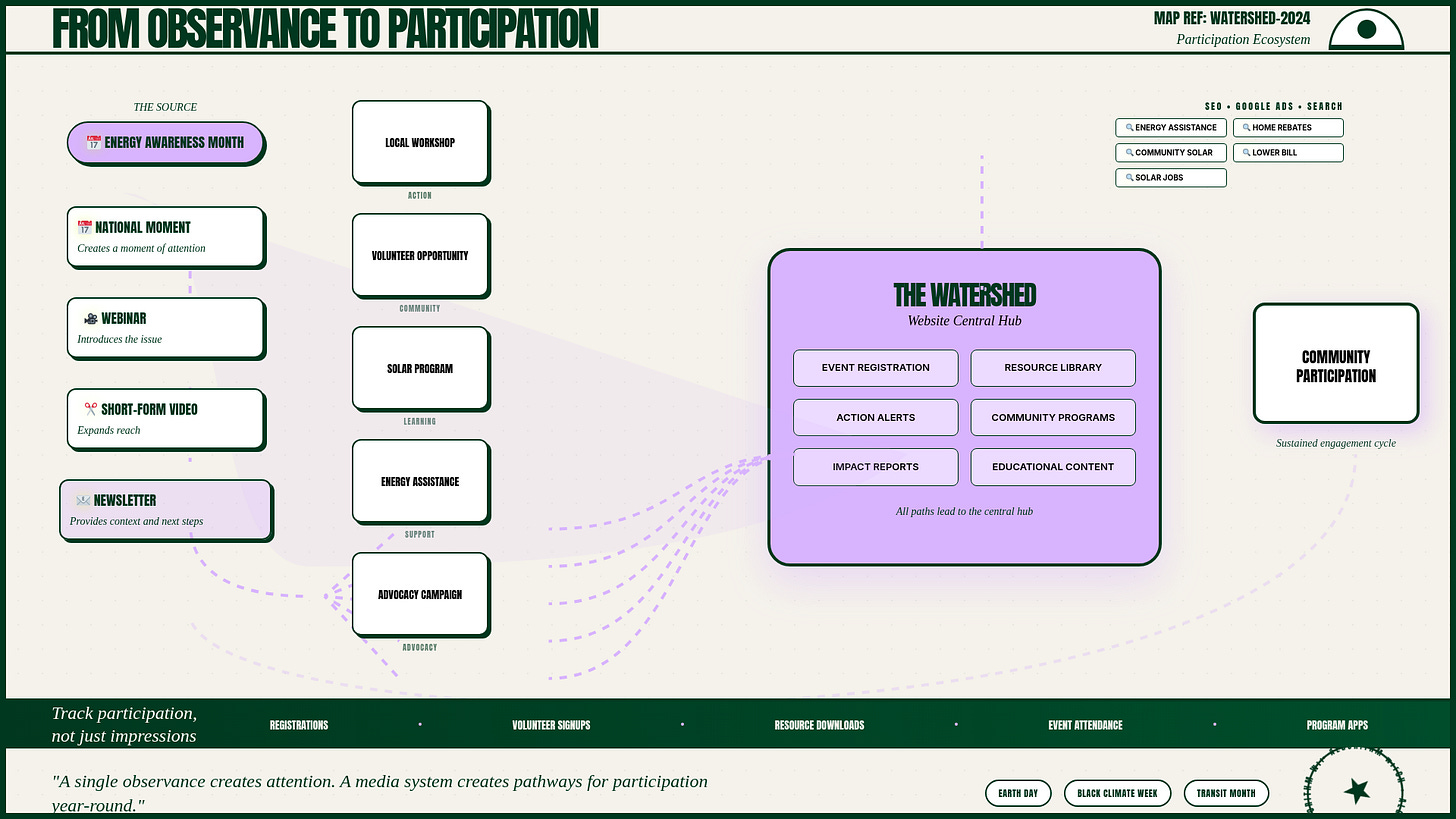
The watershed extends further. Someone searches for energy assistance. Another searches for home electrification rebates. Maybe your friend searches for community solar in their city. Search engine optimization, Google Ads campaigns, and keyword strategies create additional tributaries that guide people toward the same resources, events, and opportunities for action. A webinar attendee, newsletter subscriber, search visitor, and social media follower may arrive through different channels, yet each enters the same ecosystem.
Organizations can track which keywords generate registrations, which newsletters drive event attendance, which videos lead to resource downloads, and which campaigns generate volunteer signups to evaluate participation. The website reveals how people move through the system and where they choose to take the next step. As search, recommendation systems, and AI retrieval reshape discovery, websites continue helping people find resources, register for events, access programs, and participate long after a social post disappears. The most effective campaigns treat their websites as a live community feed that helps people enter, navigate, and remain connected to the work over time.
04The Future of Climate Communication Is Media Systems
There are new tributaries into the movement. Climate organizations once relied on a handful of shared moments to bring people together. Those moments are still foundational, yet fewer people are gathering in the same places at the same time. More people are discovering issues locally through the realities of their daily lives.
That creates an opportunity. Earth Day does not have to stand alone. Climate organizations can build calendars that extend beyond traditional environmental observances and reflect the ways environmental issues intersect with everyday life. Clean energy campaign amplifying opportunities during workforce development events. Environmental justice campaign connecting with a local community center sports club. Green infrastructures programs aligning with local mobility events. Climate runs through all of these issues, and our calendars can reflect those connections.
People join movements through the things they already care about. They show up for their neighborhood, their children’s school, their health, their utility bill, their job, their local park, or a challenge facing their community. Expanding a calendar creates more opportunities for people to encounter the work through those existing interests and relationships rather than waiting for a climate-specific observance to bring them into the conversation.
The future of climate communication could be focused on creating more points of connection. The climate, clean energy, and advocacy organizations that build lasting participation will create media ecosystems that reflect the wide swath of issues surrounding climate and community while creating new reasons for people to mobilize and take action on repeat throughout the year.