Flipping through radio stations, the fan in the corner of your room, the hum of the highway outside. In built environments we’ve become accustomed to white noise and hardly notice the endless stream throughout the day. Social media feeds have become their own place in this built environment, with closed captioning and stop-the-scroll around every corner. Brands have to compete with a consistent stream of content designed to capture attention. So how do you stand out from the white noise while posting with a relentlessness that matches content creators?
As a personal content creator, you can make content as life happens to you. You share the book you just finished, the conversation that changed your perspective, the project you’re building, the mistake you made this morning, or the question you can’t stop thinking about. Your life creates a continuous stream of observations that can become content you just need to decide that aspect is worth documenting.
Personal creators can document a life, but brands have to build one. Most climate, clean energy, and advocacy organizations don’t have a daily life people naturally want to follow. Organizations launch a campaign, publish a report, celebrate Earth Day, and then ask the same question every communications team eventually reaches: What do we post now? I usually approach that question by asking what the data from previous campaigns already tells us. Which topics generated conversation? Which formats consistently increased participation? Which events had the highest registration rate? Which themes repeatedly surfaced across high-performing posts? Every piece of content leaves behind another observation, making the next campaign less dependent on inspiration and more dependent on evidence.
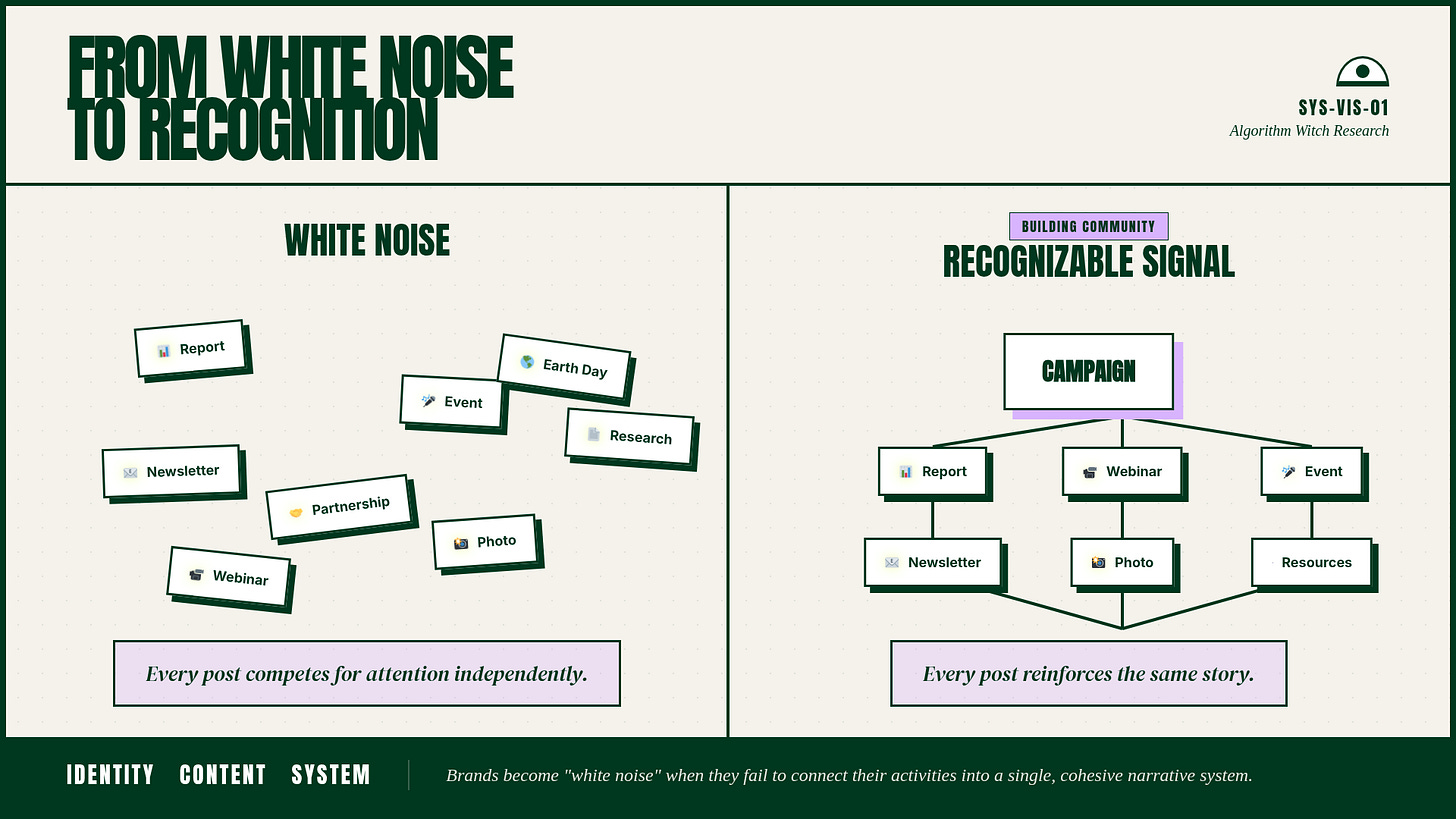
Content becomes much easier to plan when your evidence is organized. Pillars create consistency by defining the recurring themes your organization wants to become known for. Campaigns create experiments by allowing those themes to appear in different formats, audiences, and moments throughout the year. This is why categorizing your work into pillars and campaigns becomes so valuable. Instead of asking what to publish next, you’re asking what you’ve already learned and how the next campaign can improve on it. Every campaign produces more data, every dataset strengthens the next campaign, and over time your communications system becomes progressively easier to sustain because it is learning from itself.
01Your Brand Pillars Are Your Compass
Every organization has recurring themes that shape its work. Education, leadership, advocacy, community, research, empowerment. Those themes become the foundation for campaigns, campaigns create timelines, and timelines generate content. Instead of asking what to post next Tuesday, you’re documenting work that’s already unfolding.
Think of your pillars as a compass, they provide direction for your communications over the course of a year, ensuring your audience repeatedly encounters the ideas your organization wants to become known for. When content is created without that structure, campaigns drift toward whatever feels most urgent in the moment, leaving some parts of the organization’s work overrepresented while others disappear from the conversation. Organizing campaigns around a defined set of pillars creates consistency because every new initiative has a clear place within the larger story your organization is telling.
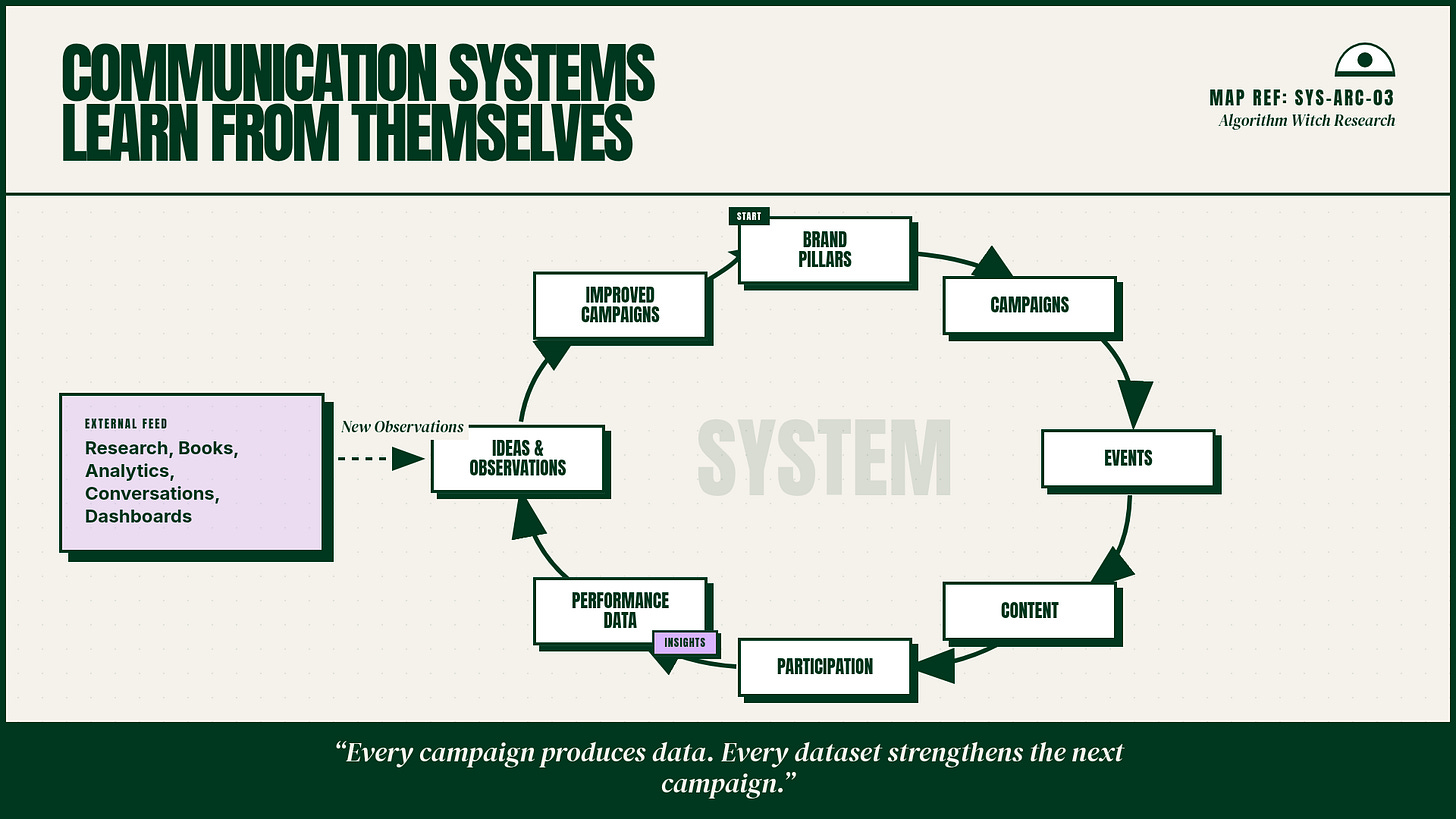
Campaigns also become easier to evaluate when they are connected back to those pillars. Instead of measuring whether a single post performed well, you can begin asking broader questions. Which pillars consistently generate conversation? Which ones drive event registrations, volunteer signups, newsletter subscriptions, or donations? Which topics resonate differently across platforms? Every campaign produces another layer of data that helps refine the next one, allowing your communications strategy to evolve through evidence in data and analytics.
02Every Campaign Should Touch Multiple Pillars
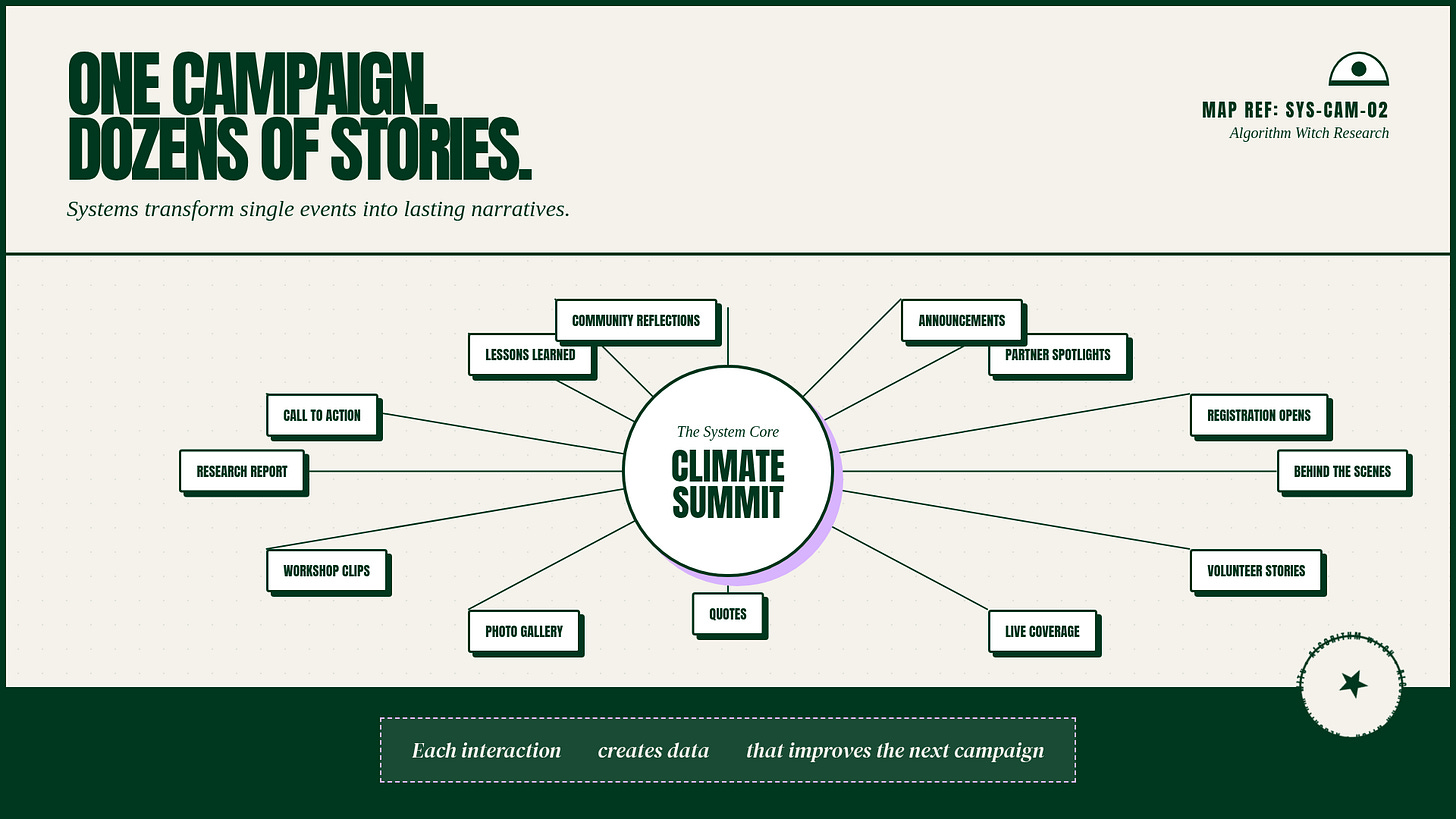
The strongest campaigns communicate across pillars. A climate summit might advance education through workshops, leadership through speaker spotlights, community through attendee stories, advocacy through calls to action, research through new reports, and empowerment through practical resources people can use after the event. One campaign suddenly becomes six different content streams because each pillar offers another perspective on the same work.
Looking at campaigns this way also makes planning easier. Instead of searching for entirely new ideas every week, you’re expanding the work already happening across your organization. Each pillar creates another angle, each angle becomes another piece of content, and every campaign leaves behind performance data that informs the next one. Over time your content calendar becomes less about filling empty spaces and more about documenting a communication system that grows stronger every time it runs.
03Your Campaigns Are Your Microphone
Campaigns amplify the work your organization is already doing. They take research, programs, events, partnerships, policy priorities, and community relationships and give them a consistent voice across every platform where your audience spends time. Rather than publishing isolated updates, campaigns organize those moments into a recognizable narrative that people can follow over days, weeks, or even months. The longer a campaign runs, the more opportunities it creates to reinforce your message while collecting data that can strengthen the next campaign.
The most effective campaigns treat each of those moments as another opportunity to reinforce the same themes from a different perspective. A webinar can educate through its content, highlight leadership through its speakers, strengthen community by featuring participants, support advocacy through a call to action, and reinforce empowerment by providing resources people can immediately apply. The event doesn’t simply create content. It creates a connected series of observations that can be distributed across platforms while continuing to strengthen the larger campaign.
When campaigns are designed this way, every post contributes to something larger than itself. Instead of searching for another idea after publishing, you’re documenting the next chapter of work already unfolding, while every interaction, click, registration, share, and conversation creates another layer of data that helps you refine the campaign the next time it runs.
04Your Events Are Scalable Campaigns
Events naturally generate moments worth documenting throughout their lifecycle. Registration opens. Speakers are announced. Partners join the initiative. Volunteers begin preparing. Behind-the-scenes planning offers a look into the work before anyone arrives. Live updates capture participation in real time, while recordings, photos, lessons learned, and community reflections continue extending the conversation long after the event has ended. A single event produces multiple social post because something meaningful is happening before, during, and after the event itself.
Events are one of the easiest ways to build a content calendar because they naturally create recurring moments worth documenting. A single webinar, conference, volunteer day, fellowship kickoff, community meeting, or advocacy day rarely begins and ends on the same day. Registration opens, speakers are announced, partners join, volunteers prepare, resources are developed, attendees arrive, conversations happen, photos are shared, lessons are learned, recordings are published, and follow-up actions continue long after the event has ended. Every stage becomes another opportunity to communicate because the work itself is continuing to unfold.
The same thinking can scale beyond a single event. Annual reports become report campaigns. Fellowship applications become recruitment campaigns. Legislative sessions become advocacy campaigns. Volunteer programs become community campaigns. Rather than treating these moments as isolated announcements, organizations can build communication systems that begin before the milestone arrives and continue after it has passed. Every campaign expands the lifespan of the work while creating more opportunities for people to encounter it, participate in it, and return to it later.
05Content Follows Momentum
Content becomes difficult when there isn’t an ongoing story to document. Organizations experience this after a major campaign ends because the communication system was built around a deadline instead of a rhythm. When campaigns, events, recurring series, and long-term initiatives are connected together, there is always another chapter beginning before the previous one has completely ended. Your communications start reflecting the continuous movement of the organization itself, instead of isolated updates.
If every post belongs to an event, a campaign, a recurring series, or a long-term theme, each piece naturally points toward the next one. Your audience begins recognizing familiar ideas, recurring language, and ongoing initiatives because every interaction reinforces the larger system. Over time they aren’t simply consuming individual posts. They’re learning how your organization works, what it values, and where they fit within it.
06Fill Your Calendar
Organizations think about filling a content calendar when the first step should be filling an organizational calendar first. Every recurring event, campaign launch, report release, webinar, fellowship, office hour, volunteer opportunity, partner collaboration, awareness month, and annual milestone creates another reason for people to return. The more recurring moments your organization creates throughout the year, the less often your communications team starts with an empty page. Content becomes the documentation of participation rather than the search for another post idea.
07Build Systems, Not Posts
Consistency comes from building systems where every campaign creates data, every event creates stories, every story reinforces a pillar, and every pillar helps shape the next campaign. Over time the organization stops treating content as individual posts and starts treating it as a continuous learning system that improves with every iteration.
For years many organizations depended on shared moments of attention. Earth Day, awareness months, elections, conferences, legislative sessions, and annual reports created a rhythm entire sectors could organize around. Those moments can no longer carry an entire communications strategy. Organizations need to build their own recurring reasons for people to return, creating calendars that reflect their programs, communities, and long-term priorities alongside the observances they inherit.
Communities form when people repeatedly connect ideas, people, resources, and experiences into a larger story. Communication systems work the same way. Every campaign strengthens a pillar, every event extends a campaign, every observation informs the next iteration, and every piece of content gives someone another opportunity to recognize your work and become part of it. Over time you’re no longer publishing isolated posts. You’re building an ecosystem people can continually return to.
That’s one of the reasons I’m building StellarSync. I wanted a place where pillars, campaigns, events, ideas, content, and performance data could stay connected instead of disappearing across spreadsheets, scattered notes, and disconnected planning documents. I want to help organizations build communication systems that learn from themselves, making every campaign stronger than the one before it while creating more opportunities for people to recognize the work, participate in it, and return when the next chapter begins.
I’m currently opening limited FREE beta access. If you’d like to explore StellarSync, you can join the waitlist here: https://stellarsync.app/contact