Every strong community develops lore. When people talk about lore online, they mean the backstory surrounding a game, television show, or fictional universe. Lore explains how things connect. It provides context for events, characters, places, and decisions. The deeper someone goes, the more pieces they discover. Online or offline, communities develop lore in much the same way.
An organization’s lore might include its founding story, major campaigns, recurring themes, influential leaders, shared language, favorite resources, memorable events, inside jokes, or lessons learned over time. Together they create a body of knowledge people can continue exploring.
Feeds excel at introducing people to pieces of a story, yet communities form when people can connect those pieces together. Someone who only encounters isolated moments may understand the topic. Someone who repeatedly encounters the same organization begins understanding the world surrounding the topic. Lore is a key component of the translation of information into building pathways for participations.
This is why long-form content is essential. Long-form environments preserve institutional memory by providing places where stories, resources, ideas, and relationships can accumulate before they disperse into the ether. Over time long-form content becomes archives of community knowledge that help new participants yearn and desire to understand what an organization does, and how they can become part of it.
01Communities Form Through Repeated Recognition
Someone encounters the same organization multiple times. They begin recognizing the language, the people, the issues, and the values associated with the work. What begins as a series of individual interactions gradually builds trust. Trust creates participation.
Communities emerge when people can return. Long-form environments create continuity. They give people a place to deepen their understanding, revisit ideas, and participate at their own pace. Over time these destinations become the infrastructure that supports community growth.
Every piece of long-form content stores lore differently. Some systems preserve it, some distribute it, others deepen it. Together, these long-form environments help transform a collection of posts into a community people can continually rediscover and plug in to engage with.
02Websites Become the Archive
Every community needs a home where its lore can accumulate. Social media profiles are rented space. Websites are places where information can remain accessible long after publication.
Someone searching for a local program, educational resource, climate job, volunteer opportunity, event, report, or community initiative is looking for a destination. As organizations build more pathways into participation, websites increasingly function as a home base where those pathways reconnect. Search visitors, social followers, newsletter subscribers, event attendees, and AI retrieval systems may arrive through different routes, yet they enter the same ecosystem once they reach the website.
If your website disappeared tomorrow, what parts of your organization’s story would disappear with it? A useful place to start is identifying the resources, campaigns, events, and ideas people reference most often, then building pathways that make them easy to find, revisit, and share. The strongest websites do more than explain what an organization does. They help people understand how they can become part of the story.
03Newsletters Become the Ongoing Story
Every edition of your newsletter functions as a new chapter for your community. People rarely build relationships with organizations through a single interaction. Communities form through repeated exposure, shared language, and ongoing conversations.
A newsletter creates an environment where people choose to return. Over time subscribers develop familiarity with the work, recognize recurring themes, and build deeper understanding than a feed can typically provide.
This is why newsletters continue growing despite every prediction of their decline. They create direct relationships that are not dependent on recommendation systems deciding whether a message should be distributed.
Every newsletter becomes another chapter in a shared narrative. Consider what someone would learn if they read your last ten newsletters in sequence. Would they recognize recurring themes, values, and goals? Would they understand where the work is headed next? Consistency matters because communities form through repeated encounters with the same ideas over time.
04Podcasts Become Oral Tradition
Every community develops stories that are easier to tell than they are to write. Podcasts create space for ideas, experiences, and relationships to unfold through conversation, allowing people to spend extended periods of time with the work.
Listeners spend extended periods of time with hosts, guests, and ideas. Conversations can develop slowly, creating space for nuance that cannot survive compression into social formats.
Partner podcasts extend this even further. When organizations appear within existing communities, they borrow trust from networks that have already formed around shared interests. A guest appearance can introduce new audiences while placing the work inside conversations people already value.
Communities often carry knowledge through conversation before they carry it through documentation. Think about which stories, lessons, and perspectives are difficult to capture in a report or social post. Those conversations frequently become some of the most valuable parts of a community’s lore because they preserve context, personality, and lived experience alongside information.
05Long-Form Video Creates Shared Understanding
Some forms of lore are best experienced together. Long-form video allows organizations to connect ideas, demonstrate expertise, and provide context in ways that would otherwise remain fragmented across dozens of shorter posts. All while building community in comments and interactions on the video itself. A four-minute video allows someone to move beyond recognition into understanding. A ten-minute explanation can answer questions, provide evidence, demonstrate expertise, and connect ideas that would otherwise remain fragmented across dozens of posts.
This becomes increasingly important for complex topics. Climate policy, public health, community development, clean energy, housing, labor rights, and economic justice often require more context than short-form environments can comfortably support.
Consider which parts of your work would benefit from demonstration. Educational series, webinars, community stories, and project walkthroughs all allow audiences to spend more time inside the work, transforming abstract concepts into experiences they can recognize and remember.
06Build Places People Can Return To
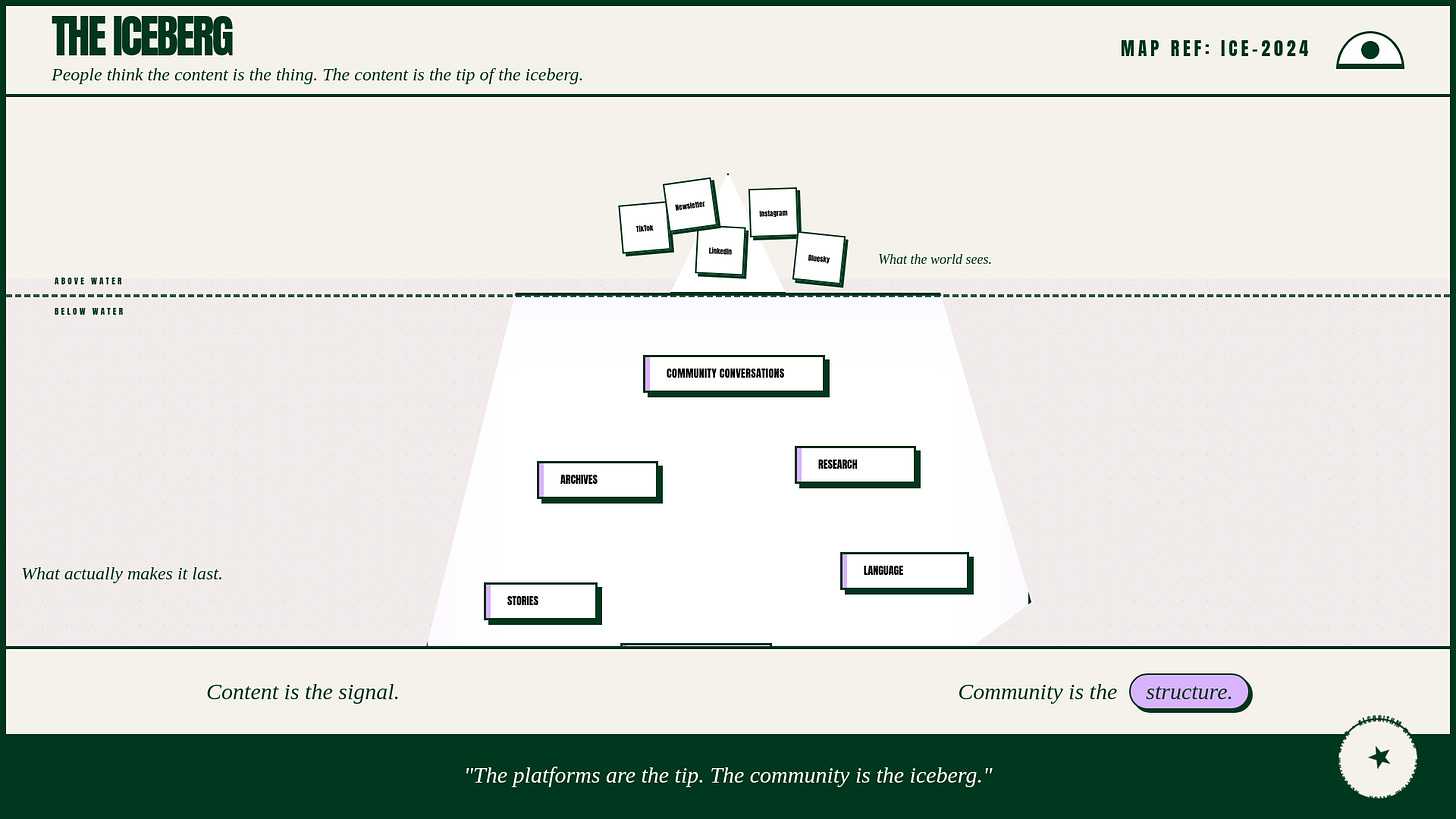
The strongest communication systems increasingly operate like living knowledge systems. Short-form content introduces people to the lore, websites preserve it, newsletters extend it, podcasts tell it, long-form video brings it to life and search and recommendation systems help people discover it. Communities form when enough people share an understanding of the same stories, language, experiences, and ideas. Long-form content creates the places where those connections can accumulate over time.