We have been blessed by the social media data gods this past month. 🙏🏽
Yes, that’s right, Sprout Social, Buffer, and HubSpot all dropped their 2026 reports and the LinkedIn Engineering blog released a new feed analysis. Across the data, one claim stood out: posting less will help growth.
It sounds tidy. It also collapses several different trends into one convenient myth.
New cross-platform engagement data suggests something more interesting is occurring. Engagement did fall on some platforms in the past year, especially Instagram and Threads. But it also grew on others like Facebook and Pinterest, and held relatively stable on TikTok. Meanwhile LinkedIn still maintains some of the strongest engagement rates in the dataset.
The real story is that feeds became denser, AI made content production dramatically cheaper, and the metrics marketers rely on no longer capture what platforms are actually optimizing for. In other words, content supply rose faster than audience attention.
Posting less does not actively help your growth. Posting less may protect your average per-post vanity metrics, but there is no dispute that not posting will hurt you. The tradeoff is aggregate growth versus per-post efficiency. I’ll explain how the data shows a fragmentation in engagement driving platform inconsistencies and unpredictability and explain why the answer is adding value with consistency and format experimentation that you have capacity for.
01What the cross-platform data reveals
Buffer’s 2026 analysis examined more than 52 million posts across major platforms, tracking changes in engagement rate and content performance between 2024 and 2025. These shifts moved in opposite directions across platforms. If engagement were collapsing across the board, we would expect synchronized declines.
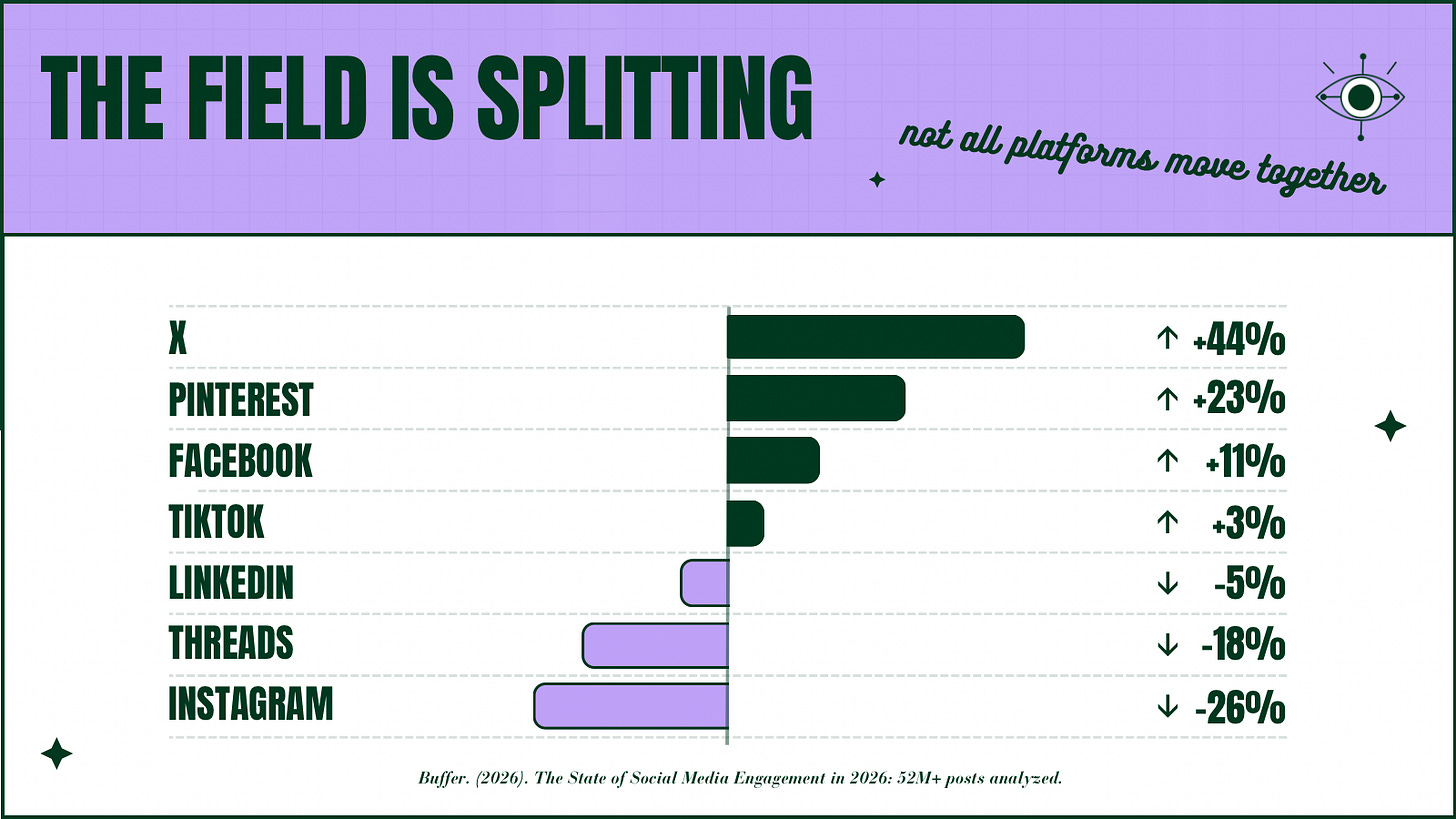
The platforms that rely heavily on relationship networks and conversational engagement held relatively steady. Platforms dominated by short-form video discovery feeds experienced sharper engagement-rate declines.
That difference implies engagement rate measures interaction relative to impressions, not reach itself. When a platform dramatically expands distribution, especially through algorithmic discovery, engagement rate can fall even if total views and audience size increase.
02The “post less to grow more” myth
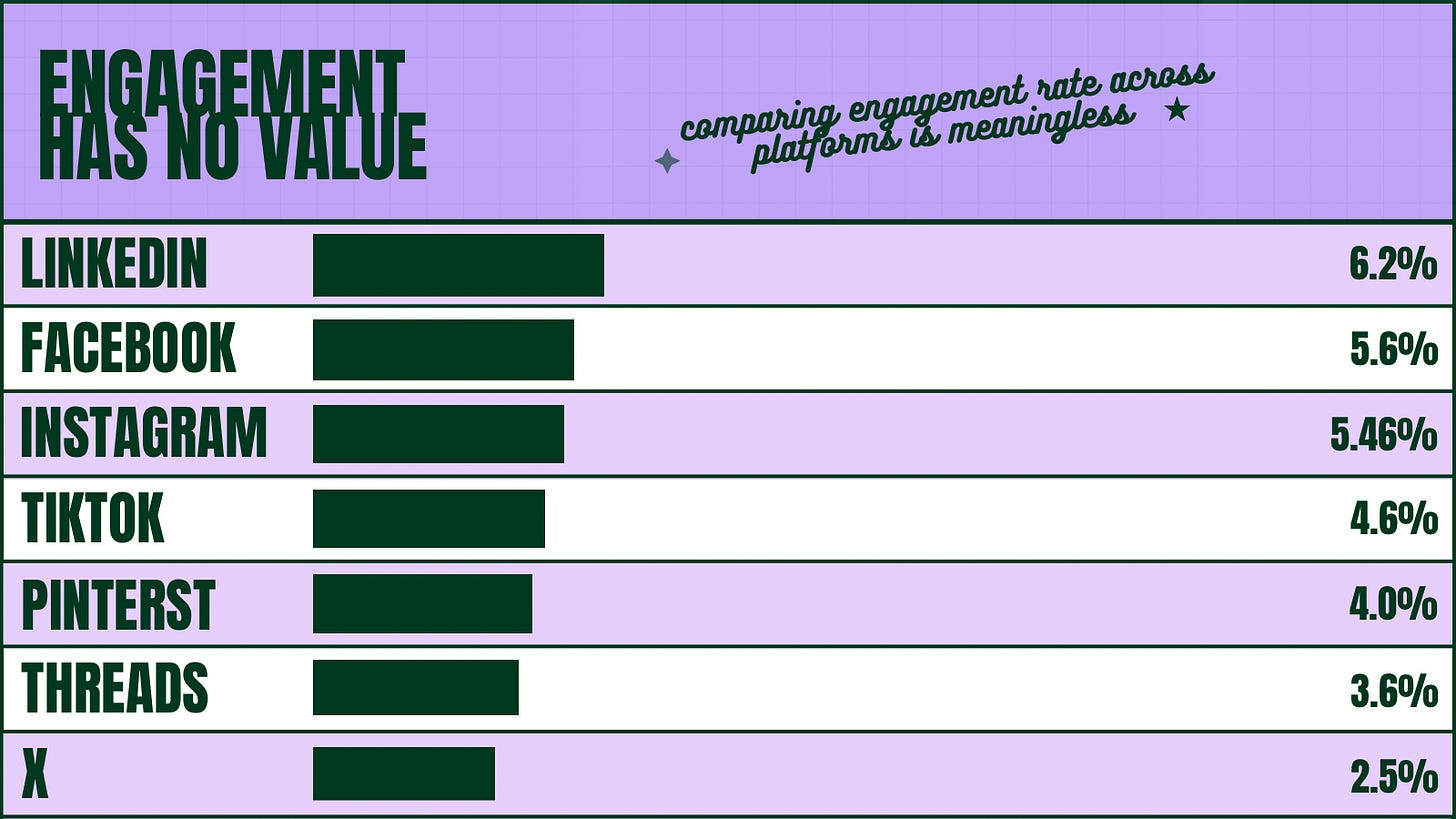
Each platform’s interaction patterns produce different baselines. A 2% rate on X might be strong. A 2% rate on LinkedIn would be failure.
Buffer’s frequency analysis complicates this. Accounts that did not post in a given week consistently underperformed their own average growth baseline. Even posting one to two times per week improved growth relative to silence. Researchers described this pattern as a “no-post penalty.”
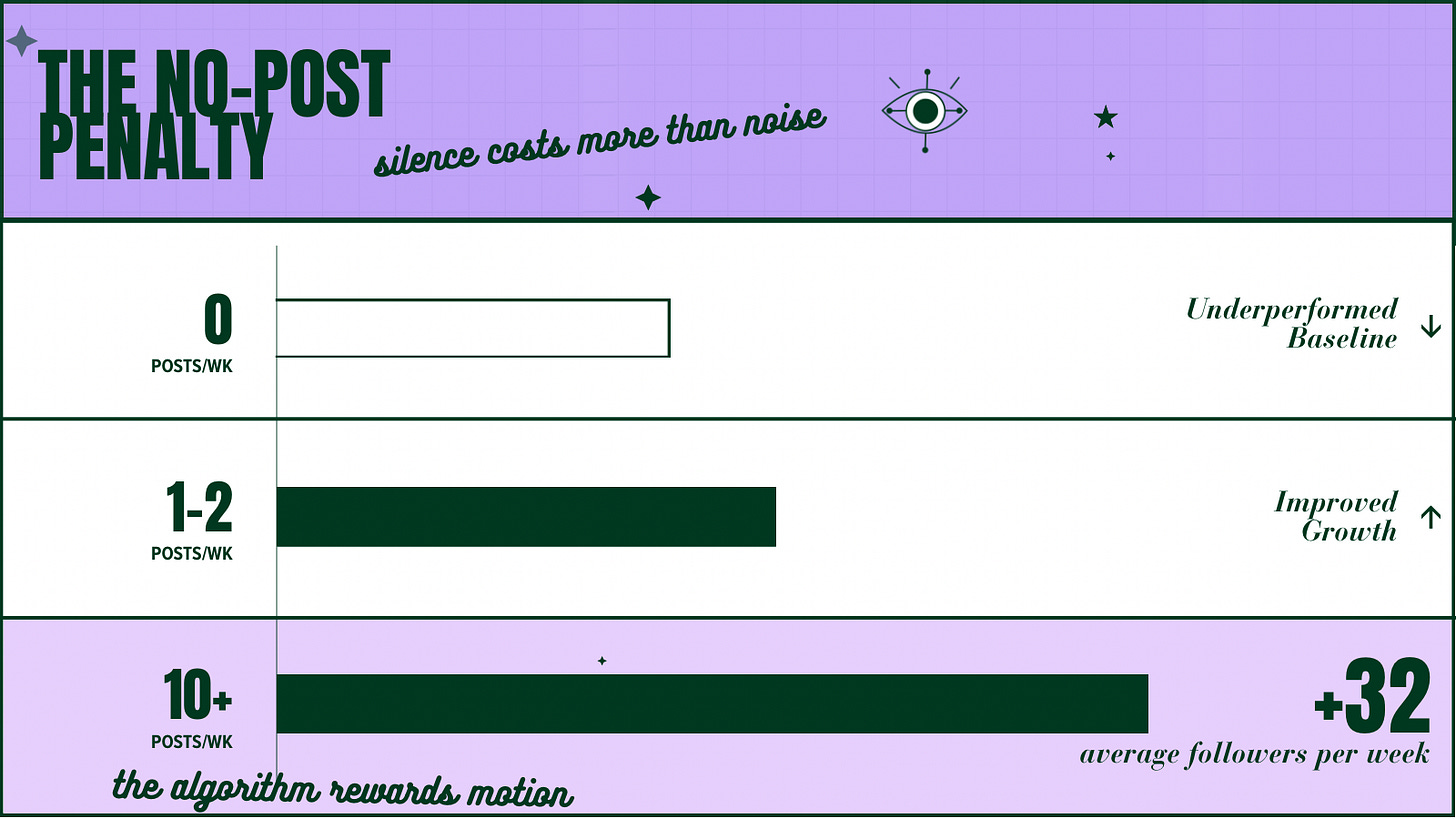
However, they also found something that explains why the “post less” narrative persists. As posting frequency increases, reach per individual post often declines. Posting more can increase total audience growth while simultaneously lowering the apparent efficiency of each individual post. So marketers looking only at per-post engagement metrics might conclude they should post less. But if they zoom out to total reach and follower growth, the opposite may be true. So when looking at what metrics should drive your strategy, you should consider your own growth and efficiency goals. For example, you might find link clicks are more valuable than impressions and that some platforms don’t drive clicks. That can help you identify which platforms are worth your energy, which are worth the commitment to drive growth, and which ones aren’t efficient.
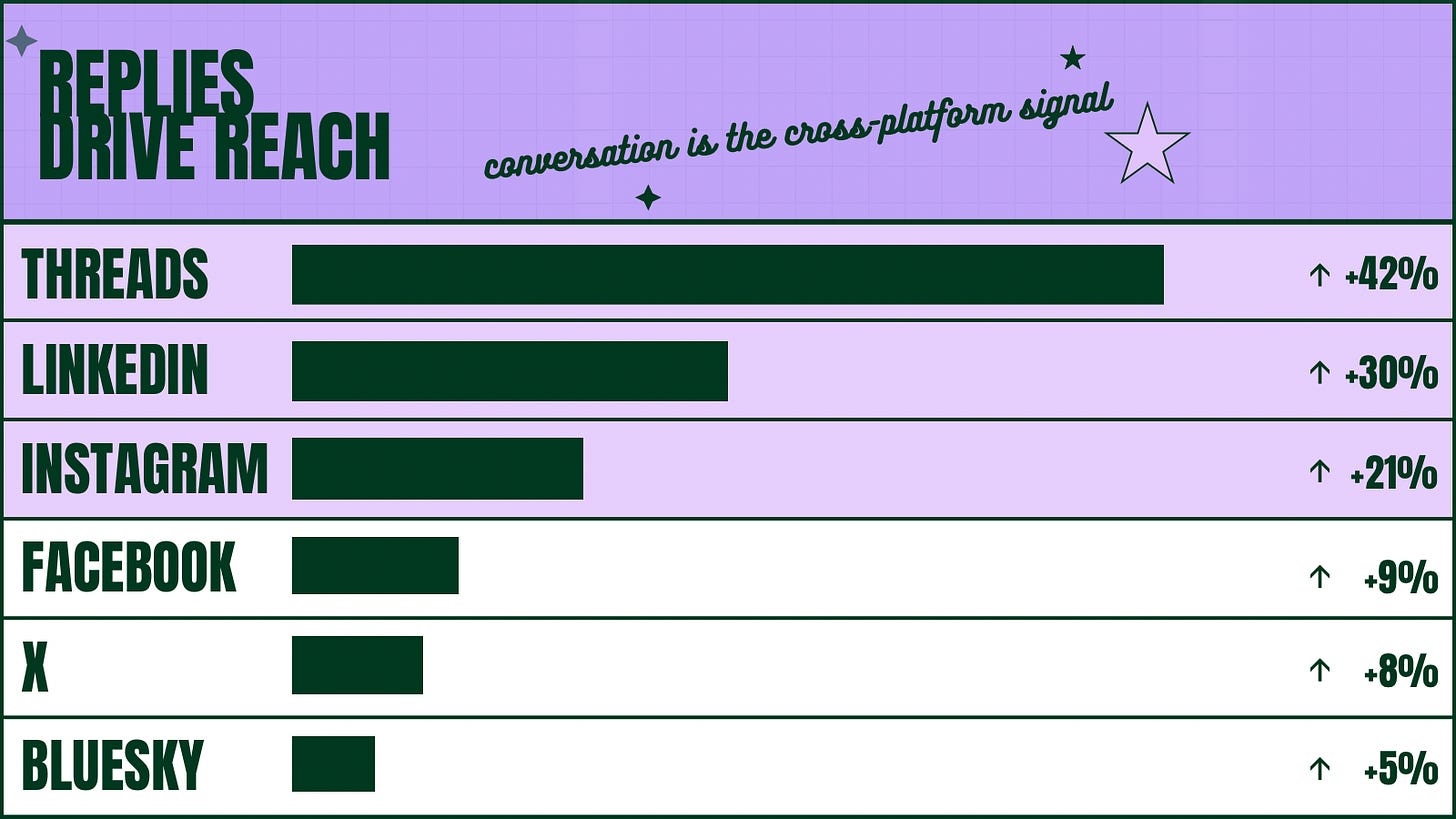
Frequency is part of the story, but across six platforms, Buffer also found that posts with replies present consistently outperformed those without, with the largest lifts on Threads and LinkedIn. Replies are one of the few cross-platform behaviors Buffer found consistently associated with stronger engagement. Conversation signals are becoming one of the most consistent ranking inputs.
LinkedIn’s Engineering blog points to deeper shift in how the feed operates. Ranking no longer relies only on actions like clicks, reactions, comments, and re-shares, or even dwell time. The system now interprets what a post is about and how it aligns with a user’s evolving interests, using those patterns to decide what should be seen next. That means even on a platform with relatively strong engagement rates, surface interaction counts capture only a small part of how distribution actually works.
Fragmentation is also visible in audience behavior. Sprout’s 2026 data shows a widening gap between where audiences plan to spend more time, led by Facebook, Instagram, and YouTube, and where brands plan to pour more effort, led by TikTok and Instagram.
03The AI supply shock
There is another structural change influencing engagement: AI.
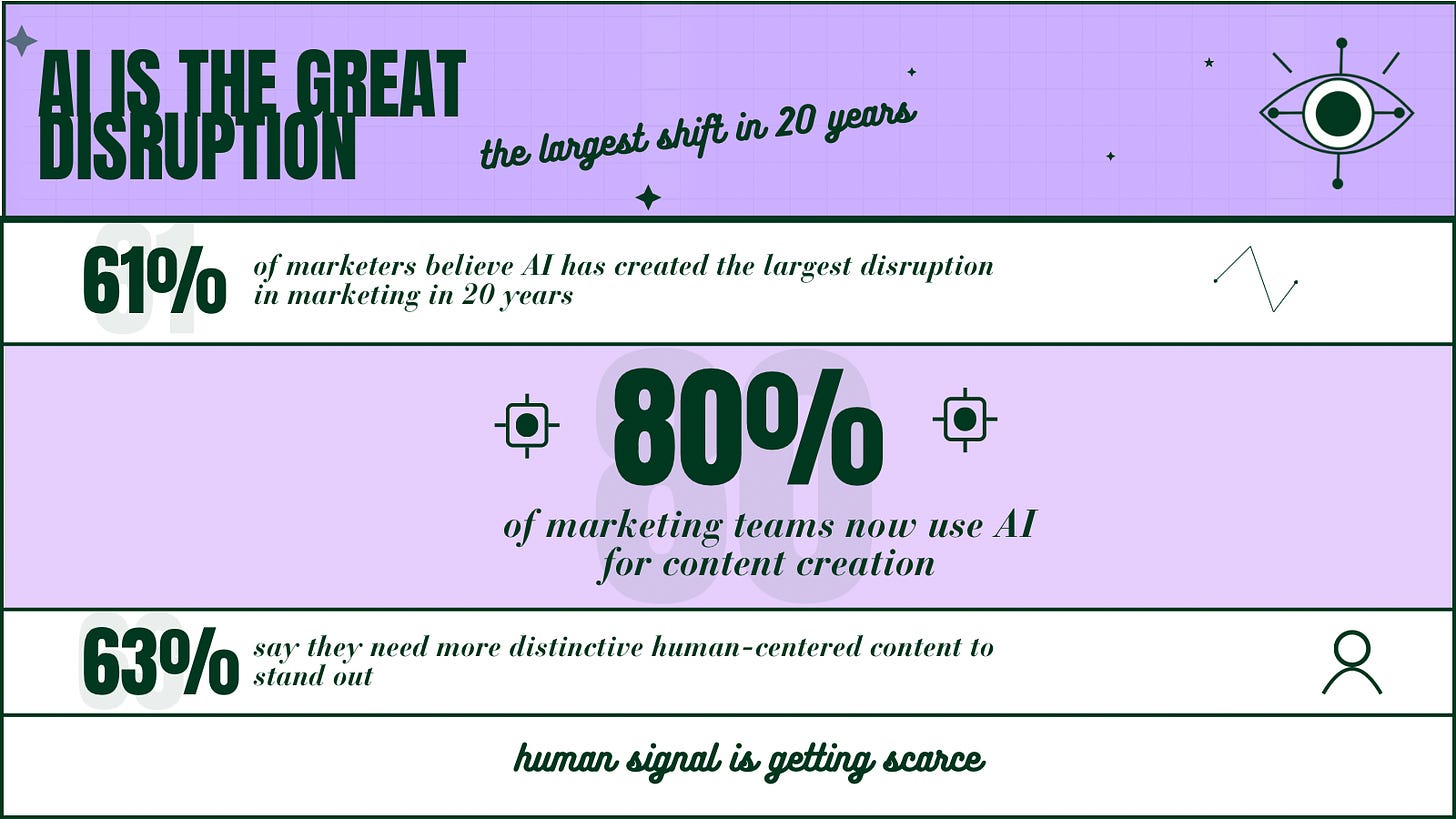
Given that 80% of teams now produce AI-assisted content, the feed’s content supply has likely grown dramatically without an increase in audience attention. As production costs fall, the volume of content competing for attention rises. The feed becomes denser even if audience demand stays the same and the result is a classic supply shock. Content volume rises faster than attention capacity. The average quality of posts decreases while the number of posts increases. In this environment, engagement rates fall even if audience demand remains stable. Platforms respond by leaning more heavily on algorithmic filtering, predictive ranking, and recommendation systems. All of this has created a landscape where distribution becomes less predictable and differentiation becomes more valuable.
AI-assisted content production has increased the volume of visually similar posts in the system, which raises the importance of consistent positioning and recognizable framing for classification models. These structural decisions become necessary when you look at how individual platforms behave. Each network distributes content through a different ranking system, which produces very different engagement patterns. The only way to gain traction is to be accessible and available to classification.
04Platform analysis
This is exactly why I built the Platform Stack Quiz. To find which platforms fits your team, your content capacity, your audience, and the way your organization already communicates. The breakdown below is meant to help you think like a strategist building a stack that can hold.
Instagram experienced the largest engagement-rate drop in the dataset. Buffer notes that the platform has increasingly pushed creators toward views as a primary success metric, which makes engagement rate a less complete measure than it used to be.
Previously, Instagram distribution was more tightly anchored to the social graph. Meta reported that Reels now account for more than 50% of time spent on Instagram. So when engagement drops on Instagram, that it may simply mean the metric marketers being used are outdated. Video reach expanded dramatically, which increases impressions faster than interactions. Meanwhile Buffer’s data shows that carousel posts still generate the highest engagement rates, while Reels produce the most reach.
That pattern suggests Instagram now operates through two parallel systems: Reels function as discovery infrastructure, while carousel posts create depth through saves, swipes, and longer viewing time. Engagement-rate declines may reflect the shift toward discovery content.
For climate, clean energy, and advocacy teams, the practical application of Instagram should be treated like a two-layer communication system. Reels help organizations reach new audiences and introduce issues to people who may not already follow them. Carousels and explainers then convert that attention into understanding through save-worthy information and deeper context. Organizations that perform well on Instagram tend to treat the platform as an extension of their knowledge base.
TikTok
TikTok engagement remained largely stable year over year with Buffer data showing engagement shifting only +3% year over year. The platform rewards high posting volume and rapid experimentation because viral distribution creates asymmetric upside. Large-scale analyses of social platform performance show TikTok engagement rates changing only modestly relative to other networks, even as overall content volume increased across platforms.
Unlike Instagram, TikTok does not rely primarily on a follower graph for distribution. Content is tested through recommendation cycles in the For You feed, which makes the platform behave more like a continuous experimentation environment than a traditional social network. TikTok’s own documentation describes the For You system as ranking videos using signals such as watch time, completion rate, likes, comments, shares, and replays to determine whether a video should be distributed to broader audiences.
Posting less on TikTok usually means running fewer experiments, which lowers the probability of breakout performance. Because videos are distributed in staged recommendation waves, early retention and engagement signals determine whether the system expands reach to progressively larger audiences.
For communications teams, this structure favors organizations that treat TikTok as a learning environment. Short, conversational videos explaining a policy change, reacting to news in your field, or showing staff discussing their work often outperform highly produced campaign videos because they generate stronger watch time and comments. Consistent posting increases the number of experiments the system can run on your content, raising the likelihood that one piece will break beyond your existing audience and introduce new supporters to the organization.
LinkedIn experienced a modest engagement decline but still maintains one of the highest median engagement rates in Buffer’s dataset. The strongest format remains document carousels, which consistently generate higher interaction than most other post types.
LinkedIn’s Engineering blog helps explain why. The platform’s feed ranking system has shifted toward a model that understands what a post is actually about and how it connects to a user’s evolving professional interests. Instead of relying only on network proximity or early engagement, the system uses large language models to classify content semantically and match it to patterns in what people have been reading, engaging with, and returning to over time. The system looks at sequences of engagement to predict what someone is likely to find useful next, which means content that aligns with a user’s current line of thinking is more likely to travel beyond an author’s immediate network.
Conversation still plays an outsized role in that process. Buffer’s analysis shows posts that receive replies see roughly 30% higher engagement, and profiles that regularly respond to comments outperform those that do not. LinkedIn Engineering similarly describes the feed as a relevance-ranking system designed to surface professional conversations users are likely to participate in, differentiating that from content they might passively consume.
For climate organizations, the accounts that perform best tend to publish ideas that invite discussion. Staff experts sharing perspective on policy changes, program outcomes, or field research outperform brand posts because the system recognizes the author’s topical authority. In practice, this makes LinkedIn more of a public forum where organizations build credibility through participation.
Threads
Threads saw one of the sharper engagement declines in the dataset. At the same time, it still shows the largest engagement lift from replies, roughly 42%. That pattern suggests the system continues to reward conversation depth rather than passive consumption.
That structure aligns with how Meta has been positioning Threads as a public discussion space. Distribution increasingly blends interest modeling with conversation signals, which means posts that generate sustained replies continue traveling further through the network.
For organizational communications, this creates an opportunity for perspective and commentary. Posts that frame a policy update, respond to breaking news in your field, or ask a clear question often generate stronger reply chains than announcement-style posts. In practice this means the platform behaves like a hybrid between Twitter and Reddit, where thoughtful participation compounds visibility over time.
Despite the cultural narrative that the platform is fading, Facebook is surprisingly one of the most stable environments for brand interaction.
Facebook’s feed blends social graph ranking with interest modeling, which means content from organizations people already follow continues to receive consistent distribution. In contrast to discovery-heavy platforms, engagement on Facebook tends to accumulate through existing relationships and repeat interactions more reliably.
Consumer research also shows Facebook remains one of the primary places users expect to interact with brands for customer support and information. That expectation keeps organizational pages relevant even as newer platforms attract more cultural attention.
For climate, clean energy, and advocacy organizations this stability can be significant. Facebook often performs best when it functions as a community layer. Updates about programs, local events, volunteer opportunities, or policy changes tend to perform well because audiences already have an existing relationship with the organization. The platform may not be sexy, but it continues to operate as a durable infrastructure for maintaining public connection.
Pinterest operates as a hybrid between search and social discovery, which makes it less vulnerable to the engagement volatility affecting purely feed-based networks. Unlike traditional social feeds, Pinterest really functions like a visual search engine.
The Pinterest feed is indexed around intent signals such as keywords, image recognition, and user saving behavior. That structure allows posts to continue circulating long after publication rather than disappearing quickly in a chronological or algorithmic feed.
Video has become more prominent on the platform, but static images and instructional graphics still perform strongly because they align with how users search and save content. Engagement on Pinterest accumulates through saves and rediscovery rather than rapid comment cycles.
For nonprofit organizations this creates a different kind of opportunity. Educational graphics, explainers, resource guides, and visual summaries of research can continue attracting traffic months after they are published. In practice, Pinterest behaves like a long-tail discovery layer where useful information compounds over time.
Reddit operates differently from most social platforms because content distribution is governed primarily by community voting and moderation structures. Visibility depends on how users upvote, comment on, and share posts within individual subreddits, which makes Reddit function like public forum infrastructure.
This structure shapes how organizations should approach the platform. Consumer research from Sprout Social suggests Reddit tends to work better as a listening environment instead of a traditional publishing channel. Communities are highly sensitive to promotional behavior, and posts that read like scheduled marketing content are often ignored or removed by moderators.
Organizations that succeed on Reddit usually participate as contributors: answering questions, sharing expertise when relevant to a discussion, and engaging within established communities. Providing string-free expertise on Reddit can generate more credibility than pushing links or campaign announcements. For advocacy teams, the platform can be valuable for understanding public sentiment around policy issues, identifying emerging narratives, and participating in conversations where genuine expertise is welcomed.
Twitter (X) recorded one of the largest engagement increases in the dataset, but that number requires caution. The platform’s monetization and verification changes significantly altered distribution dynamics over the past year.
Buffer’s analysis suggests engagement among non-premium accounts has dropped sharply in some segments, with median engagement approaching zero in certain months. That pattern indicates engagement growth may be concentrated among a smaller set of accounts that receive algorithmic prioritization.
The shift is likely connected to changes in the platform’s subscription and verification systems, which influence visibility in replies, recommendations, and conversation ranking. As a result, the engagement environment on X may be structurally distorted relative to earlier periods when distribution was less tied to account status.
For nonprofit organizations this creates a volatile strategic landscape. Accounts that do not participate in the platform’s paid features may never see their posts travel. X could function as a real-time commentary space during major news cycles, but relying on it as a consistent reach channel has become significantly less predictable without buying into the platform.
05What this means for strategy
Taken together, these datasets point to a structural change in how social distribution works.
Engagement is diverging and each platform’s distribution model now produces its own engagement pattern. Platforms built around conversational networks and relationship graphs have remained relatively stable, while platforms centered on algorithmic discovery have seen sharper engagement-rate declines as reach expands faster than interaction.
Posting less does not appear to improve growth. Across millions of accounts, Buffer’s analysis consistently shows that silence consistently underperforms even modest publishing activity. Accounts that stop posting temporarily protect their per-post engagement averages, but they also disappear from recommendation cycles, conversation threads, and follower feeds. Growth slows because the system has fewer opportunities to evaluate and distribute new content.
AI has also revolutionized the economics of content production. HubSpot’s research shows that most marketing teams now use AI in their workflows and that a majority believe it represents the largest disruption to marketing in decades. The cost of producing content has dropped dramatically, but the supply of attention has not increased at the same rate. In practice that means the feed has become denser while audience attention remains fixed. 
Those structural changes explain the patterns visible across platforms. Instagram expanded discovery through Reels, which increased impressions faster than interactions. TikTok continues to function as a large-scale experimentation environment where breakout distribution depends on retention signals. LinkedIn and Threads reward conversation depth through replies and discussion threads. Pinterest behaves more like search infrastructure where useful content compounds over time. Facebook remains anchored in relationship networks that sustain stable engagement among existing communities.
When these systems are compared side by side, the idea that “posting less improves quality” becomes harder to support. The platforms still reward consistency and experimentation and certainly favor volume, within a clear editorial frame, above silence.
The strategic question you have to consider is how to produce enough signal for the system to understand what you are about.
06The feed got louder
The modern feed processes a far larger volume of content than it did only a few years ago. Much of that content is now produced with AI assistance, which means posts can be generated faster and at greater scale than before.
Platforms respond to that density by leaning more heavily on prediction systems. Ranking models evaluate not only likes and comments but also dwell time, completion rate, conversation depth, and behavioral patterns that signal genuine interest. LinkedIn’s Engineering blog, for example, describes ranking models that incorporate multiple engagement signals alongside semantic relevance and expertise classification.
The result is a distribution environment where visibility depends on consistent patterns. Algorithms need repeated signals to understand what an account represents, who its audience is, and which users are likely to find its content meaningful.
For organizations working in climate, policy, and advocacy communications, a steady cadence of publishing helps classification systems identify topical authority and audience alignment. Conversation signals such as replies and discussion threads increasingly influence how far posts travel. Platforms built around discovery reward experimentation, while platforms built around relationships reward participation. When content volume increases, differentiation becomes more valuable.
AI lowered the cost of production but did not lower the cost of taste. The challenge now is not simply to produce more content. It is to publish consistently enough for the system to recognize your signal while developing a point of view strong enough to cut through the noise. In the AI era, clarity is becoming one of the scarcest resources in the feed.