Remember being a kid at your local playground? Where I grew up in New York, we’d take the Subway across the city to experience different parks. A slide? A tire swing? These were hot commodities in kindergarten and I was lucky to have the time and opportunity to explore them. All public goods are like this, and it’s a barrier to government trust and collective action that we need to address. There are hidden costs to access that we ignore when we have it, which makes it harder to expand opportunity because the people with access rarely have to think about how it works or how to extend it.
If we entertain the fact that sustainability, clean energy, and climate are only accessible to some, because it allows climate and clean energy public goods to proliferate in small ways, then we will continue to fail to address the largest barriers to the clean energy transition. We must demand a community-led energy transition for climate and clean energy. A community-led movement will both center communities in the benefits of climate investments and promote mass adoption on a local level.
Adam Elman, Director of Sustainability for Europe, the Middle East and Africa at Google, said, “the era of vague, sweeping corporate sustainability pledges is over.” The brands that are adapting, are messaging around tangible value and focusing on affordability.
Campaigns grounded in real, material outcomes hold attention longer and build credibility faster because they give people something concrete to respond to. And increasingly, with the transition from “climate change” messaging to weather and energy bills, we are seeing that people are engaging with and recognizing climate in the way they always have: through their community and lived experience.
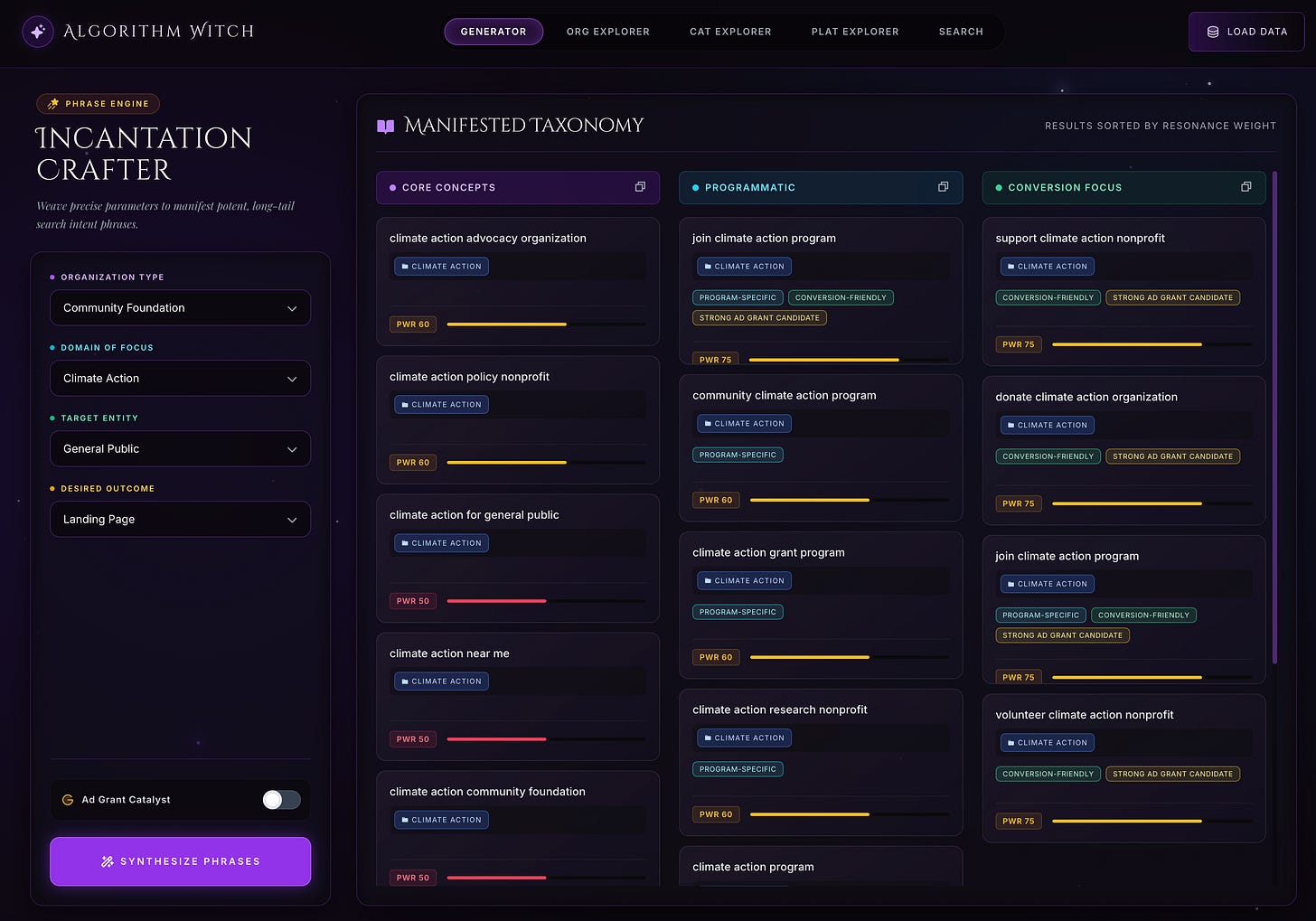
I wanted to build a tool that could test what I was seeing in digital spaces against real data. I built what I now call the Incantation Crafter, a practical way to help clients and paid subscribers find language that actually works across platforms. So, I pulled data from 320 climate organization websites. Then I mapped that language across Google Ads, YouTube, and Bluesky, using the same terms and the same weighting system across each environment. I expected relative consistency and the same terms I’ve seen across the climate movement for years. What I saw was a gap between how organizations describe the work and how people experience it, and I want to explain why that has me optimistic for the future.
01What does the language say?
For this analysis, I analyzed how language functions in practice for climate, clean energy, and advocacy organizations. I focused on “justice” as a core search term because it sits at the center of how the climate movement defines itself. Environmental justice has become one of the primary frameworks for organizing climate work, shaping how organizations describe their mission, their values, and their priorities. It carries historical weight, ties together climate, health, and economic conditions, and signals who the work is meant to serve. At the same time, it is a term that does not always travel cleanly across platforms or into public-facing language, which makes it a useful way to trace how meaning holds, shifts, or drops off as it moves from institutions into lived experience.
Across 329 organizations, justice shows up in 50.5% of cases somewhere across category, keywords, or internal phrasing. Most of that sits at the category level, where 47.7% of organizations use justice to define the work.
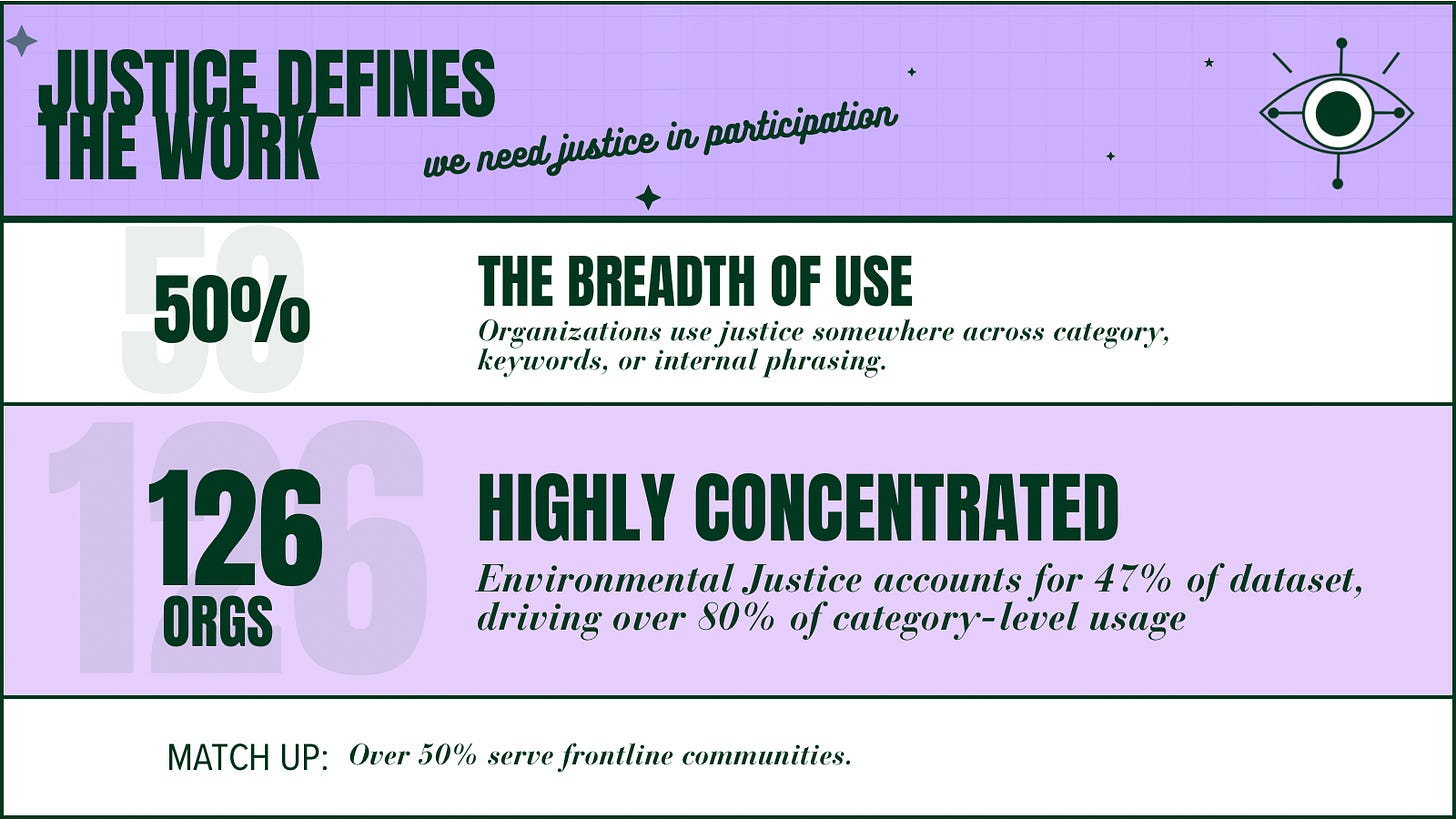
Environmental Justice accounts for 126 organizations, or 38.3% of the dataset. Over 50% of organizations reference frontline communities as a target audience.
I also conducted a weighted analysis to look for patterns across organizations. Across 867 keyword rows, 41.5% connect to justice through direct language or category association.
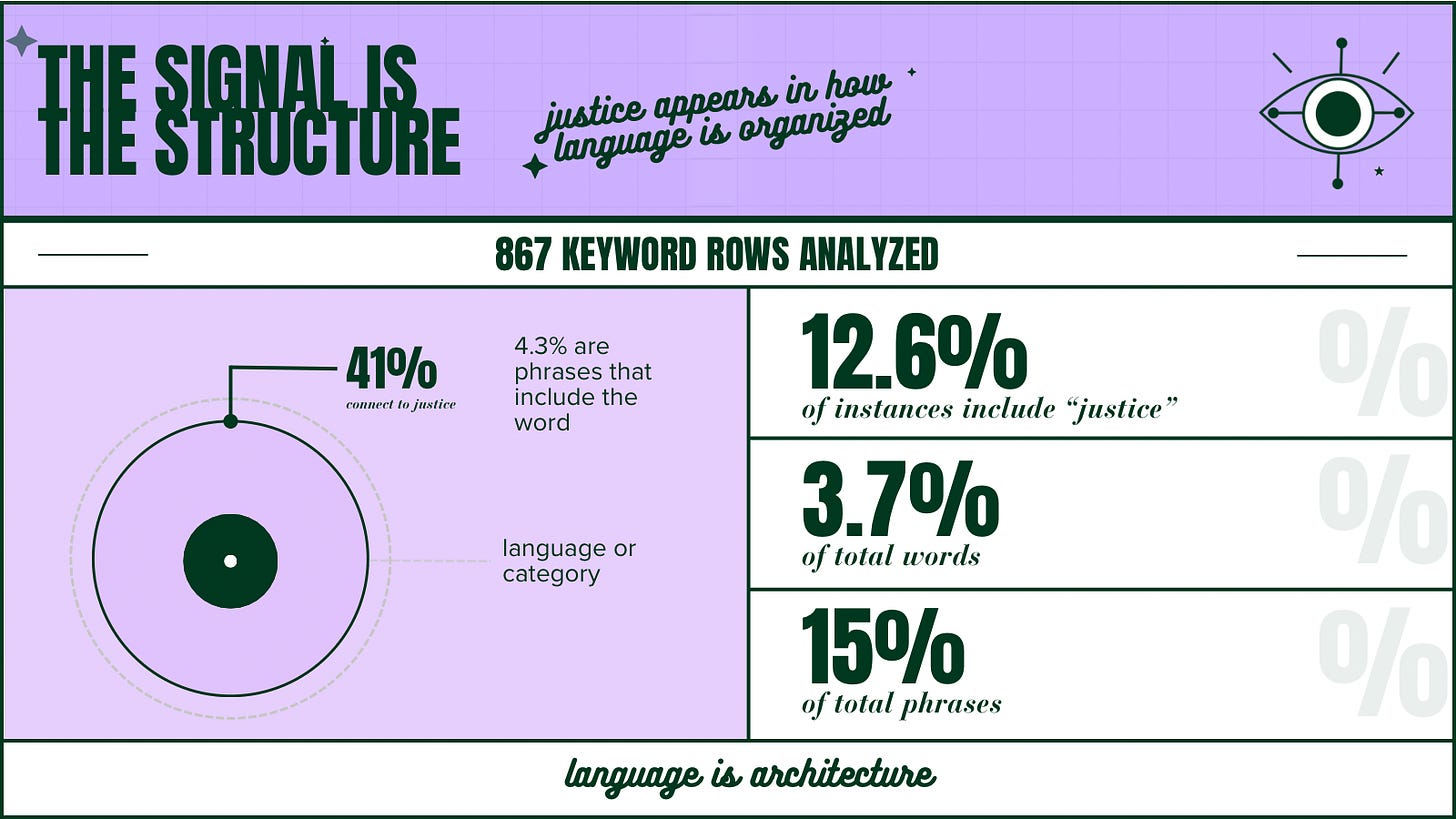
The signal sits in how language is organized. At the phrase level, 12.6% of instances include “justice,” and phrases containing it account for 15% of total words. Justice appears in just 3.7% of total words but anchors 41.5% of weighted keyword structure
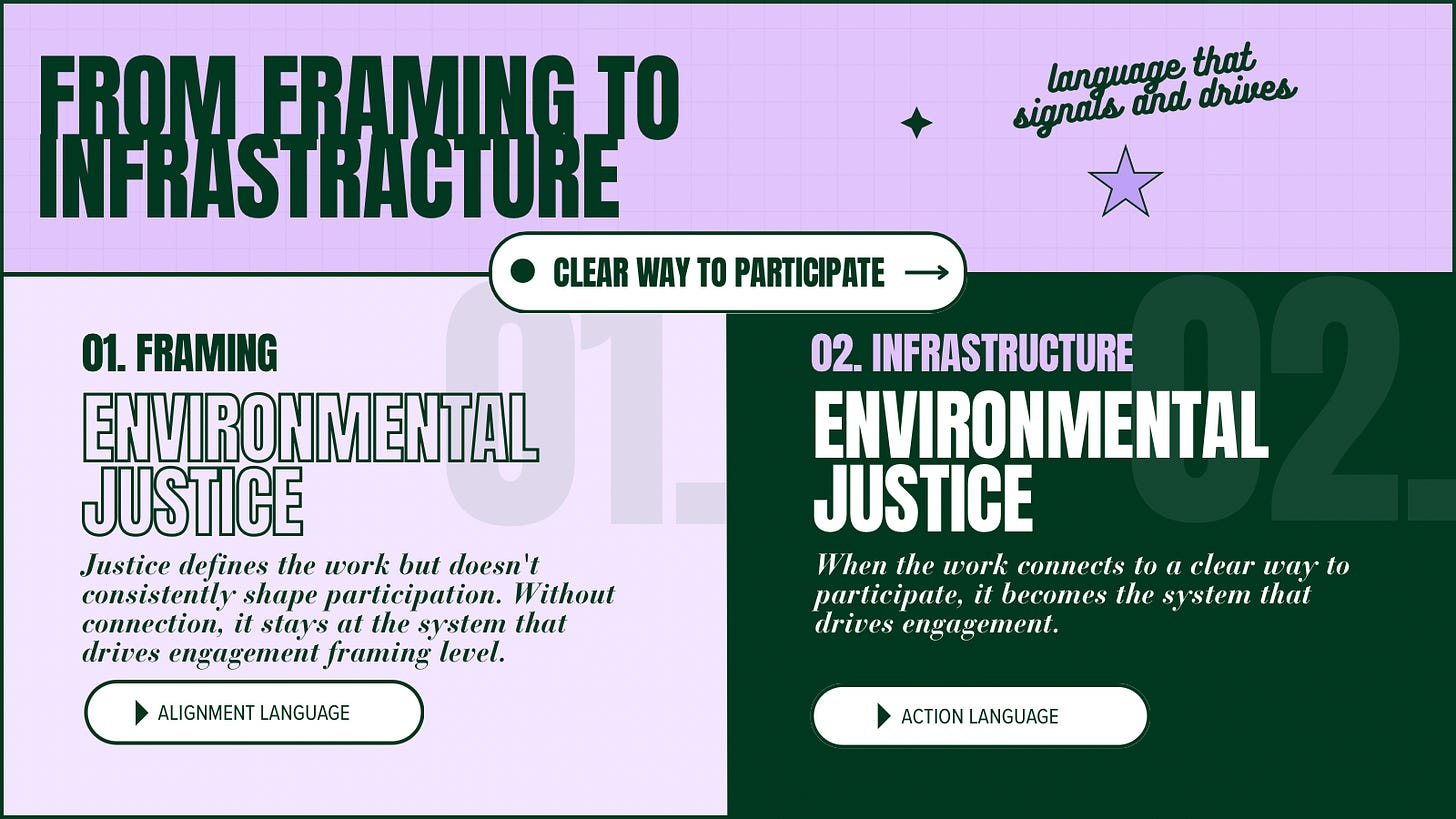
Across the dataset, justice defines the work broadly, but isn’t consistently shaping how people engage in practice. That gap separates definition from participation.
When environmental justice connects to a clear way to participate, it creates infrastructure to bring people to the work. Without that connection, it stays at the level of framing. This is the gap between language that signals alignment internally and language that can actually drive participation externally.
02What do platforms reveal?
On Bluesky in particular, climate language clusters around immediate experience. Weather, local conditions, direct impact. You see fragments that point to lived reality, grounded in what people are actually dealing with. Less than ~5% of extracted phrases align with institutional language like justice or policy. But when expanded to include weather, seasons, and local conditions, experience-based language increases by up to 10–20x.
The language stays close to experience because that is where recognition happens. People are encountering climate through heat, smoke, flooding, storms, and disruptions to daily life.
YouTube maintains higher alignment with institutional language than Bluesky, but still reflects movement toward explanatory and experience-adjacent framing
Organizational language carries structure and defines the work in a way that makes sense internally and across institutions, but it does not always translate into how people first come into contact with the issue. Platform language decides whether something applies to the audience, whether it feels relevant, and whether it is worth paying attention to.
Language tied to lived experience carries more weight in early attention, while institutional language continues to organize the work internally. The gap between the two defines how people encounter the issue, and whether they recognize a way to take action.
03Where does the gap lead?
The climate movement has spent the last decade building scale through abstraction. Most of the large climate investments in the U.S. assume people can spend money in order to save money. That shapes who can participate. Clean energy tax credits, for example, skew toward households with enough income and enough flexibility to front the cost and wait for reimbursement. If you can’t absorb that gap, you’re effectively locked out, even if the program is technically available to you.
Programs that are designed to reach lower-income communities follow this pattern. The IRA’s low-income solar bonus pushed tens of thousands of projects into qualifying areas, but the qualification was tied to geography rather than community beneficiaries. Most projects met the requirement by being located in a low-income community, without a mechanism to ensure the savings actually reached residents.
When the language of a movement stops matching lived experience, participation thins out. The issue is recognition. People need to see where they fit inside the work. Right now, that path has an income barrier. The result is a movement that can describe its goals clearly while leaving the point of entry less defined. This pattern shows up in how access is structured, and it clarifies how participation is distributed.
If the largest climate investment in U.S. history is easier to access with existing capital, that shapes who enters first and how quickly benefits are felt. You get deployment without distribution. The infrastructure exists, but the benefits don’t land evenly. This is where the transition starts to split. It can scale quickly while still concentrating early advantages among people who already have the ability to participate because the design assumes a baseline of access that doesn’t exist.
You can see that tension again when it moves from households to state policy. New York built one of the most aggressive climate frameworks in the country, and now it’s running into the same constraint at a larger scale. The state is trying to reconcile emissions targets with cost of living pressure, and the response has been to delay timelines, adjust targets, and reconsider how progress is measured. The policy requires costs to show up first: carbon pricing, electrification, infrastructure buildout. All of it increases costs in the near term and distributes benefits later. Even under more optimistic scenarios, households would feel higher energy costs before they see savings come back through incentives or system changes.
If participation requires absorbing short-term cost, then participation will follow income. At the household level, that shows up in who claims tax credits. At the state level, it shows up in whether a policy can hold under pressure. The transition can never reach meaningful scale while access remains conditional, especially when the programs designed to expand participation still rely on the same assumptions about cost and entry.
04How about attention and trust?
Looking across all four datasets, the pattern resolves into something consistent with how distribution already works. Justice holds a central role inside climate communications. Once that language moves into public platforms, it spreads out, and other forms of language start to carry more weight. Experience, place, and immediacy begin to do more of the work.
This aligns with how platforms are actually ranking content now. Feeds are layering proximity into that system, learning where you are and anchoring attention in physical context.
Attention follows that behavior. In the YouGov data, heavy social media users skew younger, with Gen Z making up the largest share, and they move through content, ads, and discovery as one continuous environment. Nearly 50% of users discover products through social and digital ads, but peer recommendations remain the leading driver of trust. This reinforces why language grounded in lived experience travels further than institutional framing
We see this play out in how language travels. Content that connects to lived experience holds attention longer because it fits into how people already process information. It gives someone a way to place themselves inside what they are seeing.
Language that stays at the level of definition organizes, it allows signaling across institutions. Language that connects to place and experience will determine who recognizes themselves inside it, and who decides to take part.
05Where are we going?
This is what the tool was built to surface. The Incantation Crafter tracks how language carries across systems, where it holds its meaning, where it starts to thin, and where it needs to be translated to stay legible. It makes visible something that is usually felt but not measured, which is how far language can travel before it stops connecting.
This dataset makes it clear that the challenge is where language is expected to support structure. Language is carrying too much of the burden for access, for trust, and for participation, and it cannot solve those gaps on its own.
The organizations that will adapt fastest are the ones that treat language as part of infrastructure. Those who designed messaging alongside access, distribution, and participation from the beginning. That is where alignment starts to show up across platforms, and where recognition becomes easier.
There is also a change happening in how credibility is built. Institutional authority is no longer enough to carry language across environments. People are looking for signals that feel close to their own experience, which means credibility is being formed at the level of community, not just at the level of organization. That changes how influence travels, how information spreads, and how movements grow.
It also changes how success should be measured. Reach alone does not tell you whether language is working. Engagement alone does not tell you whether someone can act on what they are seeing. The more useful question is whether someone can locate themselves inside the work, and whether there is a clear way to take part once they do. That is where language and structure finally meet.
The gap you see across this analysis is already reshaping how the transition unfolds. As cost, proximity, and trust continue to define entry points, the center of gravity will keep moving toward community-level experience. That is where recognition happens first, where participation becomes possible, and where momentum actually builds. This is why models that remove upfront cost and localize access are foundational. Community-based financing, direct pay mechanisms, community benefit agreements, and community-led project design are already showing a different entry point. These programs reduce upfront barriers and make participation visible at the local level. When those structures are in place, language does not have to carry the entire weight of explanation. People can see where they fit.
This is already informing how I structure keyword systems, platform strategies, and content distribution for client work. Grounded in how language behaves across systems rather than how we expect it to. If you are trying to understand how your language travels, where it starts to lose connection, or how to design for participation from the start, this is exactly what The Algorithm Witch does.