The patterns you keep returning to without prompting, the ideas that reappear in conversation, notes, and half-finished drafts. In a feed where content volume has expanded faster than attention, that repetition becomes the signal platforms use to recognize what you are building and who it should reach.
That’s where my alternate realities series came from. I kept circling the same question about how systems shape different futures. Here’s the first video in that series, where I started mapping those futures into simple, repeatable formats that can carry across episodes.
A series compounds when each video reinforces the same language across captions, spoken words, and visuals. Platforms are interpreting those layers together to understand topic and audience, and that alignment increases the likelihood that the content is returned to people who have already shown interest or are adjacent to it.
That pattern becomes easier to sustain when it is anchored in something already practiced, since formats like cooking, reading, sports, and art function as established behavioral lanes that audiences recognize immediately, allowing the content to enter through familiarity while carrying a more specific perspective inside it. That’s why employee advocacy campaigns built around centering an employee’s hobby works so well, since hobbies already exist as social media topics that people and algorithms can recognize. As a brand, entering through those formats leverages existing lexicons so the audience already knows how they are being taught, the message just has to show up clearly inside something they already understand
As those elements repeat, the series functions as a keyword system, where language across profiles, captions, and video structure determines how far it travels and whether it continues to surface across feeds, search, and recommendation systems.
01What is employee advocacy?
Employee advocacy is what happens when the inside of an organization becomes visible through the people who understand it, where employees translate the work through their own voice, context, relationships, and expertise.
In Workshop’s April 22, 2026 discussion on employee influencers, the common thread was that these programs work when they begin with people who already want to share. Advocacy cannot be built from a stack of prewritten posts; it has to come from employees who see value in spending their time and social capital on the organization’s story.
Employee advocacy operates as a trust system. Sharon O’Dea, author of Digital Communications at Work, describes the foundation as a balance between what the organization needs and what the employee gains. When value flows only toward the brand, the program becomes extractive. The central question is why someone would share this with their own network, and whether the content helps them build relationships, show expertise, open a meaningful conversation, or deepen connection to the work.
Michaela McKinley, Senior Communications Strategist at Sprout Social, uses the comparison of a “street team” to describe the emotional structure, where employee advocates are posting, explaining, recommending, sharing, or amplifying the work through informal channels, and the organization’s role is to recognize that activity, support it, and give it enough structure to travel without flattening the person behind it. That pattern extends into how hobbies, niche interests, and personal formats operate. An employee who spends time with music, books, cooking, sports, art, or community events already has a language of participation they can carry into the brand.
An employee advocacy program feeds the page with human context, giving it material that reflects how the work is carried in practice. When employees show up with clarity and the page remains static, the difference becomes legible, and that separation weakens continuity between internal language and external presence. A company page that functions as a window into the organization brings colleague features, values-based content, educational posts, and employee-generated stories into the same surface, allowing the page and the people to reinforce a shared signal of trust.
Employee advocacy connects internal culture to external visibility, where stories circulating inside the organization extend outward through people who hold that context, creating pathways for someone outside the organization to recognize the work, understand how it operates, and see where they might enter.
02How to build a video series
An employee advocacy program feeds the page with human context, giving it material that reflects how the work is carried in practice. When employees show up with clarity and the page remains static, the difference becomes legible, and that separation weakens continuity between internal language and external presence. A company page that functions as a window into the organization brings colleague features, values-based content, educational posts, and employee-generated stories into the same surface, allowing the page and the people to reinforce a shared signal of trust.
At its strongest, employee advocacy connects internal culture to external visibility, where stories circulating inside the organization extend outward through people who already hold that context, creating pathways for someone outside the organization to recognize the work, understand how it operates, and see where they might enter.
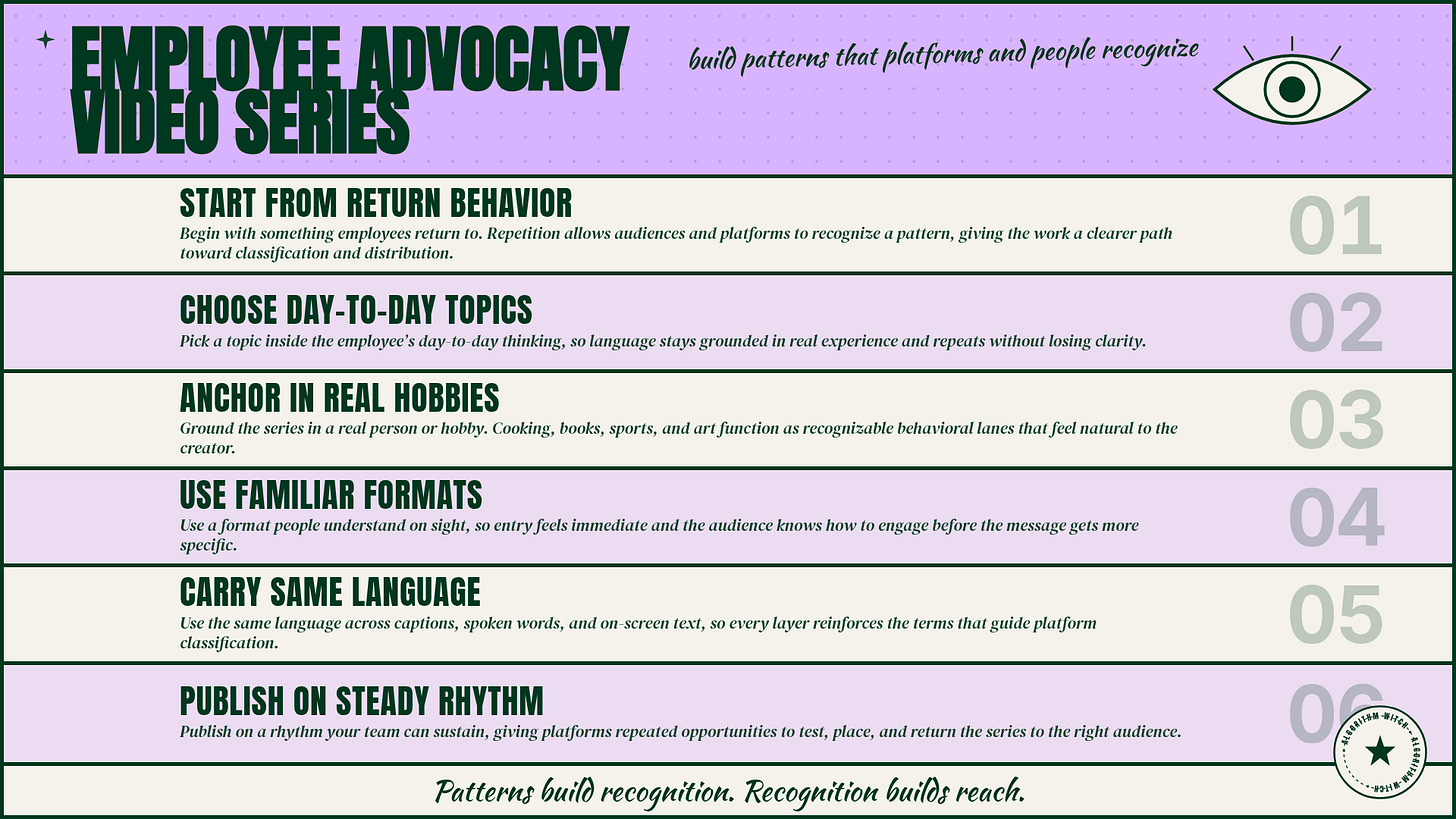
A video series becomes useful for employee advocacy when it starts from something an employee already returns to. Repetition is what allows both audiences and platforms to recognize a pattern. In an environment where content supply has increased faster than attention, that pattern is what gives the work a chance to be classified, distributed, and returned to the same audience over time.
Choose a topic that already exists in the employee’s day-to-day thinking, so language stays grounded in real experience and can repeat without losing clarity.
Anchor the series in a real person or hobby, since formats like cooking, books, sports, or art function as recognizable behavioral lanes.
Use a format people already understand, so entry is immediate.
Carry the same language across every video, including captions, spoken words, and on-screen text.
Publish on a steady rhythm, so platforms can test and distribute the content across cycles.
Let each video extend the last, so the series accumulates meaning instead of restarting.
03How platforms interpret your video series
Employee advocacy creates the conditions for language to travel, where employees carry the work through their own voice and context, and platforms decide how far that language goes based on how clearly it can be recognized and repeated. Once that system is in place, the question shifts from who is speaking to where that language is placed. Each platform interprets and distributes those signals differently, and the same idea needs to be translated across environments to continue moving.
A series compounds when each video reinforces the same language across captions, spoken words, and visuals. Platforms are interpreting those layers together to understand topic and audience, and that alignment increases the likelihood that the content is returned to people who have already shown interest or are adjacent to it.
For my series, that meant putting the core ideas directly into my bio and reinforcing them in every video, using terms like alternate realities, energy futures, and specific categories so that each post strengthens the same cluster and increases the chance that someone who watched one will see another.
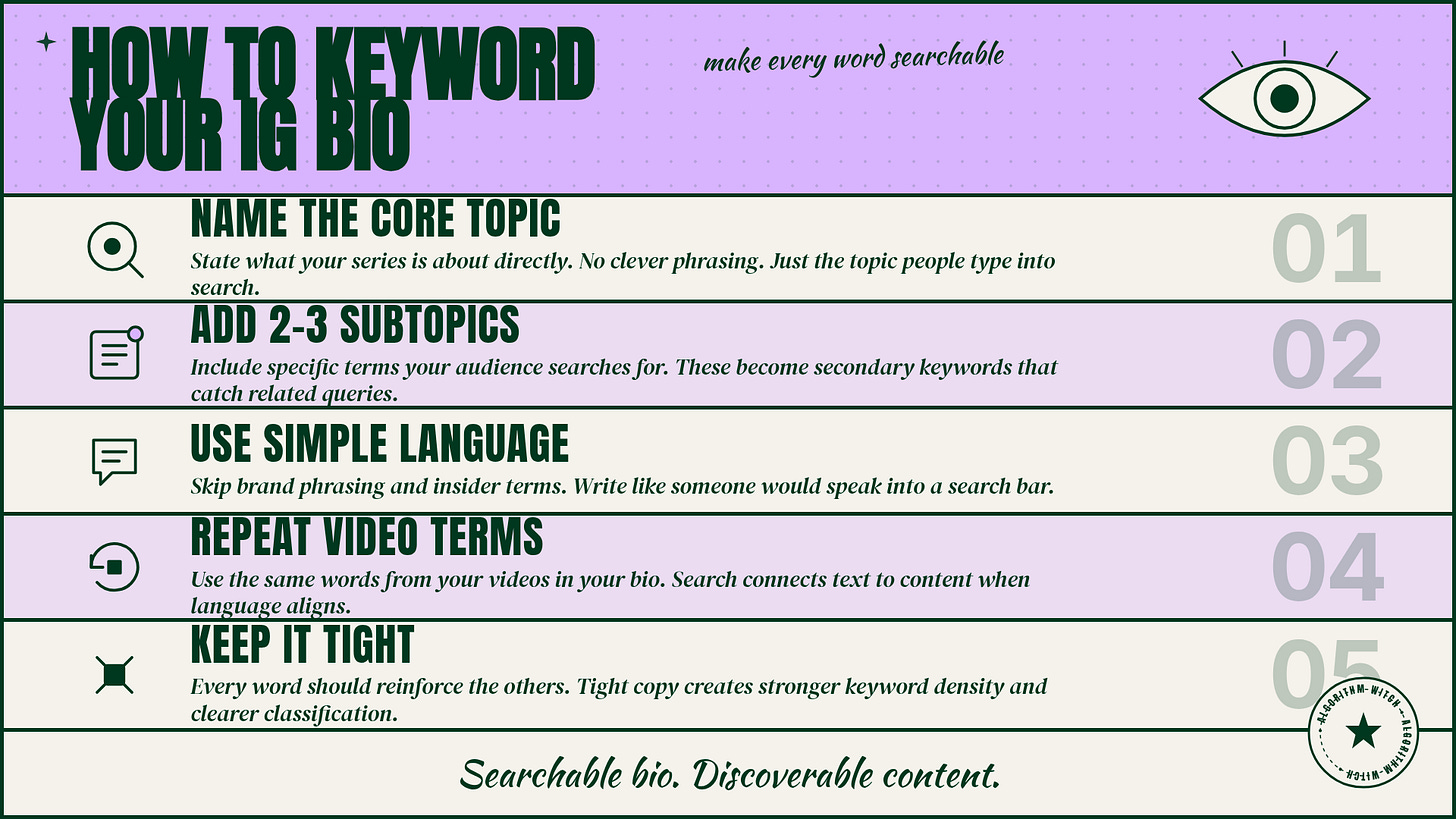
How to keyword your IG bio
Name the core topic directly (what the series is about)
Add 2–3 specific subtopics people would search for
Use simple language instead of brand phrasing
Repeat the same terms you use in videos
Keep it tight enough that each word reinforces the others
Instagram’s distribution relies on predicted interest and repeated interaction, where consistent subject and language build classification confidence over time.
On LinkedIn, the same idea expands into how you write. The feed interprets what your post is about and matches it to evolving professional interests.
Naming the topic clearly inside the post, repeating key phrases across multiple posts, and writing in a way that invites response gives the system stronger signals about who should see it, and conversation becomes part of distribution since replies consistently increase reach.
Each post adds another data point about your topic, making it easier for the system to recognize and return your content to the same audience over time.
YouTube
Playlists group videos under a clear topic, giving the platform a stronger signal about how each piece connects and allowing the series to build continuity.
Scripts carry the keyword layer directly, since spoken language is transcribed and indexed, so naming your topic clearly and repeating core terms strengthens how the content is classified and found.
Titles and descriptions reinforce that structure, which increases the likelihood that videos appear in search and are pulled into systems like Google AI overviews, where clear, repeated language is used to summarize and surface expertise.
Embed Climate & Clean Energy
Climate and clean energy is, in a sense, a hobby inside this system, something people already care about and return to, and it becomes more meaningful when small changes can be shown to lead to real changes in someone’s daily life. This gives employees something concrete to point to instead of something abstract to explain.
Climate and clean energy should inherently be a part of everything and operate as an underpinned ideology that does not need its own separate advocacy layer. The idea of apolitical clean energy and climate policy depends on it being woven into everyday systems like cost, comfort, reliability, jobs, and community conditions, which means there are already a million accessible ways to talk about it without isolating it as a standalone topic.
Climate and clean energy is not the pitch, and treating it as the pitch leaves it open to debate. It enters as a position rather than something people can recognize in their own lives. This changes how far the language can travel and who can engage with it.
The pitch is how climate and clean energy can seamlessly improve your life, and employee advocacy is how that gets shown rather than stated, where employees can point to what they work on, what they use, what they see changing around them, and how those systems show up in practice, which creates a clearer pathway for someone else to recognize it and decide where they enter.