YouTube transcripts feed data that inform Google AI overviews. LinkedIn articles are one of the most cited widely by AI tools. But not all long-form is created equal. Some content accumulates inside platforms built for publishing, but separate from distribution systems that operate across feeds, search, and AI answers. This creates a structural disconnect that causes content to exist in isolation unless it is translated into those environments, and over time that separation limits how far language can travel and who can encounter it.
I have been working through that disconnect as a systems problem, and the structure I keep returning to is what I call the three Rs, which organizes how language is produced, distributed, and sustained across platforms without requiring more output than a team can realistically support. This also separates content from direct audience notification, where platforms control who sees what, while systems like email and subscriptions allow you to reach people consistently without relying on feed distribution. This also strengthens audience recognition over time, especially in systems like email where consistency determines whether someone continues to open, read, and stay connected to the work.
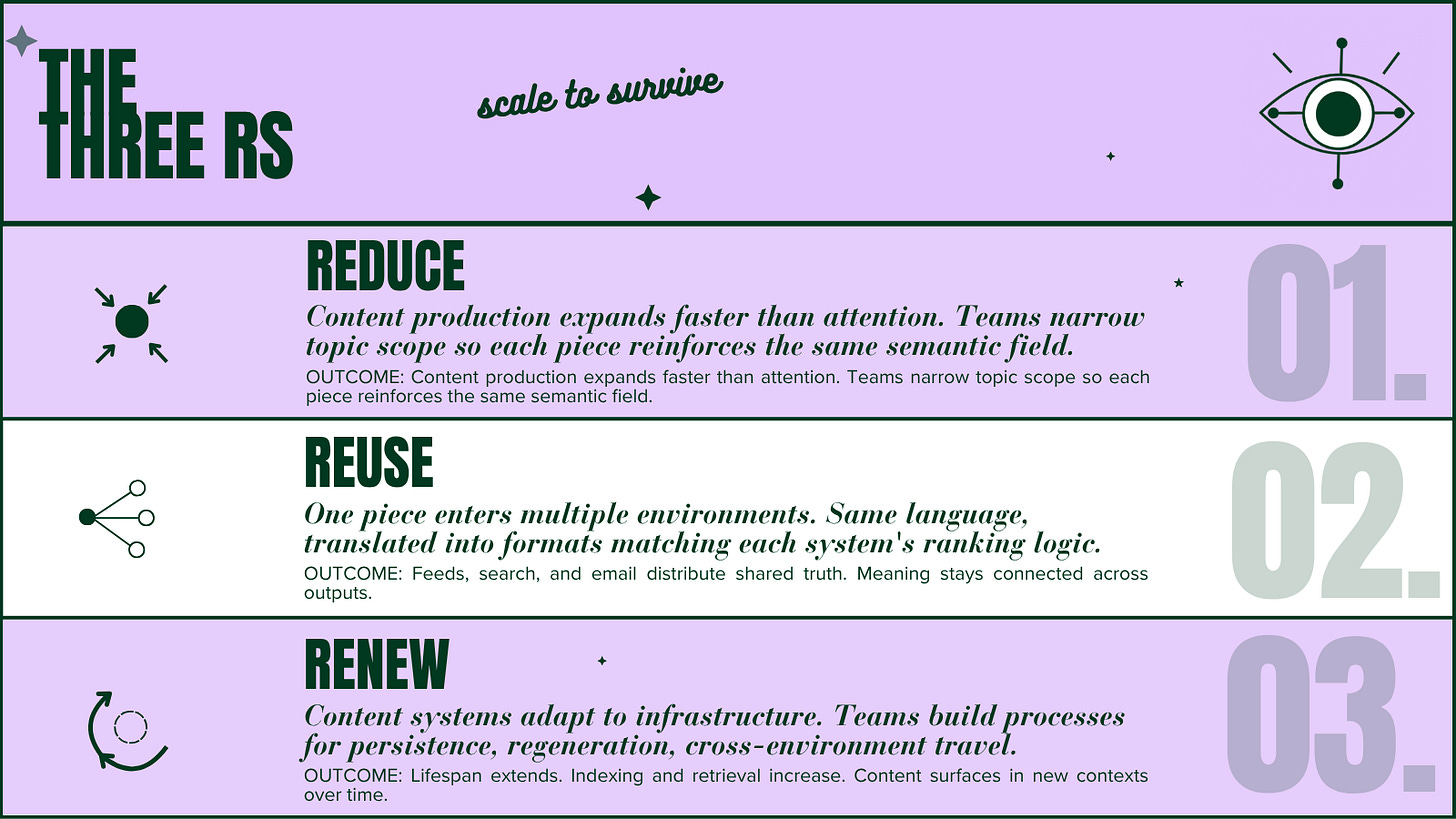
The first layer is reduce, referring to topics not total production. Narrowing the number of topics allows each idea to carry more depth and consistency across environments, which strengthens how systems classify and distribute the work. This does concentrates output, so instead of expanding into new topics that dilute expertise, organizations build a tighter semantic field that reinforce knowledge each time it appears. In practice, this could look like clear content pillars or a small number of theses that act as a shared framework for audience understanding. Theses become especially useful in reactive moments because new information can be translated through that existing framework. Algorithms interpret content and repeated topic signals strengthen classification confidence and increase the likelihood of distribution to the right audiences.
For climate, clean energy, and advocacy organizations, this reduction is tied directly to capacity, because teams often hold deep expertise across policy, infrastructure, and community impact, yet operate with limited resources relative to corporate actors, which means clarity of focus becomes a structural advantage that allows existing knowledge to travel further without requiring additional production.
The second layer is reuse, where the same piece of content is translated across platforms in ways that match how each system ranks and surfaces information, allowing one source of truth to reach multiple audiences through different entry points. Platforms already distribute based on behavioral signals, semantic clarity, and predicted relevance, which means content that is reused with consistent language reinforces its own discoverability. In an environment where content supply has increased faster than attention, reuse allows organizations to maintain presence across systems without matching the volume of higher-budget competitors, because the same long-form work can be reframed into short-form video, carousels, threads, and newsletters, where newsletters function as a direct distribution layer that does not rely on platform ranking.
This is where long-form content becomes especially valuable for climate, clean energy, and advocacy work, because complex topics rarely translate cleanly into a single post, and reuse allows those ideas to be introduced at multiple levels of depth, from quick recognition in a feed to deeper explanation in a structured format. Reuse creates a pathway from awareness to understanding rather than a single moment of exposure.
The third layer is renew, where organizations experiment with how content is created, distributed, and connected so that it can travel more efficiently across environments, adapting to how platforms and search systems evolve. Renewal is targeted experimentation that increases the mobility of content through strategies identified in reuse. This could be through new formats, new distribution pathways, or new infrastructure that allows content to persist beyond its initial publication moment. This is the layer I focused on this past week, connecting my Substack to my website through an RSS system that transforms each post into a structured, indexable page, allowing it to exist within broader search and discovery. The system pulls from the Substack feed, rebuilds each post into structured data, generates HTML pages, and standardizes layout across the site, which means every piece of content contributes to a consistent architecture that can be indexed by search engines and interpreted by AI systems. At the same time, Substack continues to distribute that content directly to subscribers, which means the same piece of work exists across search, platforms, and email without needing to be recreated.
Search and discovery are now cross-platform. Traditional SEO relies on indexed pages and internal linking to establish topical authority, AEO depends on whether content can be retrieved and synthesized into answers, and GEO emerges from whether language remains consistent enough across platforms for systems to recognize and connect it. When long-form content lives inside a structured website, it becomes available to all three layers simultaneously, increasing the likelihood that it will be surfaced in search results, cited in AI-generated responses, and reinforced through platform distribution.
For climate, clean energy, and advocacy organizations, this creates a different relationship to scale, because long-form content can act as a central knowledge layer that supports multiple forms of distribution, allowing teams to extend their reach without increasing production proportionally. Instead of competing with corporate budgets on volume or paid amplification, organizations can build systems where one piece of work generates multiple points of entry, each creating new opportunities to expand and connect with your audience.
By connecting long-form content to a structured system and distributing it across platforms with consistent language, ideas can move from recognition into comprehension and from comprehension into action. Content strategy is increasingly a question of infrastructure, where the ability to reduce, reuse, and renew content determines whether language can persist across systems long enough to be found, understood, and acted on, and for organizations working in climate, clean energy, and advocacy, that persistence is what allows limited resources to translate into collective power online and collection action on the ground.
01What tf is RSS
If you’re asking this question, you’re not alone.
Really Simple Syndication (RSS) was standard practice for written content online in the early 2000s, and then faded from public knowledge and became something platforms like Wordpress and Substack use to move content on their platforms. Many organizational blogs I’ve worked on don’t have RSS properly set up and have separate email and web management systems. The way I think about it is this: the internet has a separate system for how written content travels, but most people just aren’t using it directly anymore. That has become an advantage for organizations who do use it because it’s an underutilised way to renew your content and reach audiences. A Substack post disappears into the ether after you share it. An indexable page on Google search continues to surface, get retrieved, and reappear in new contexts over time, which means the same piece of content can persist long after it was published. That persistence becomes infrastructure, especially in an environment where AI systems and search engines prioritize content they can access, structure, and return when someone asks a question.
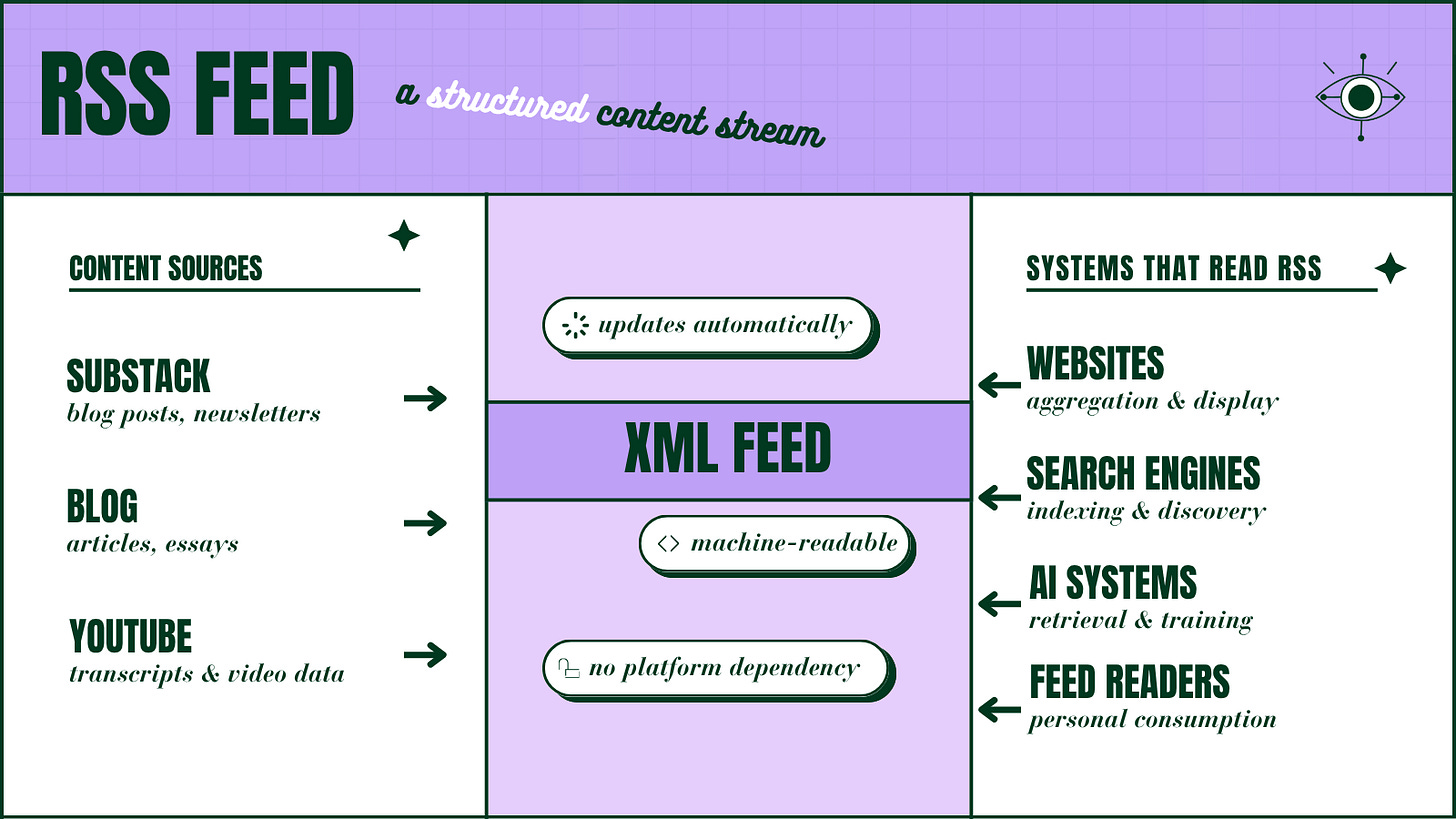
For climate, clean energy, and advocacy organizations, this creates another path to reach, where content can accumulate in systems, notify audiences through subscription and email, and extend the life of the work without requiring additional production.
Turning Substack Into a Source
I set up a system that turns Substack into a source, allowing each post to move automatically into my website without intervention. This system reads the Substack RSS feed, and translates each post into structured data that can be used across the site. Substack still handles audience notification through email, while the site handles indexing and retrieval, which separates distribution from storage and allows both to work more effectively.
The content is no longer tied to Substack as a platform and connects to everything else I’m building. Each post becomes its own page with consistent structure, navigation, and internal links, which allows the site to function as a connected archive instead of a collection of isolated posts. That consistency is what makes it legible to search engines and AI systems, because they’re not just reading one post, they’re understanding how everything connects.
For climate, clean energy, and advocacy orgs, this strategy can be deployed across long-form formats. Point content back to a single structured source: embed YouTube videos on your website, share links to your site in social media posts, and become a resource for topics you want your audience to know you are an expert in. Content that exists beyond a single platform becomes part of a broader system.
How the System Runs Itself
The system runs as a loop. Once I post on Substack it checks the Substack feed, pulls in new posts, rebuilds the site, and only updates when something has changed.
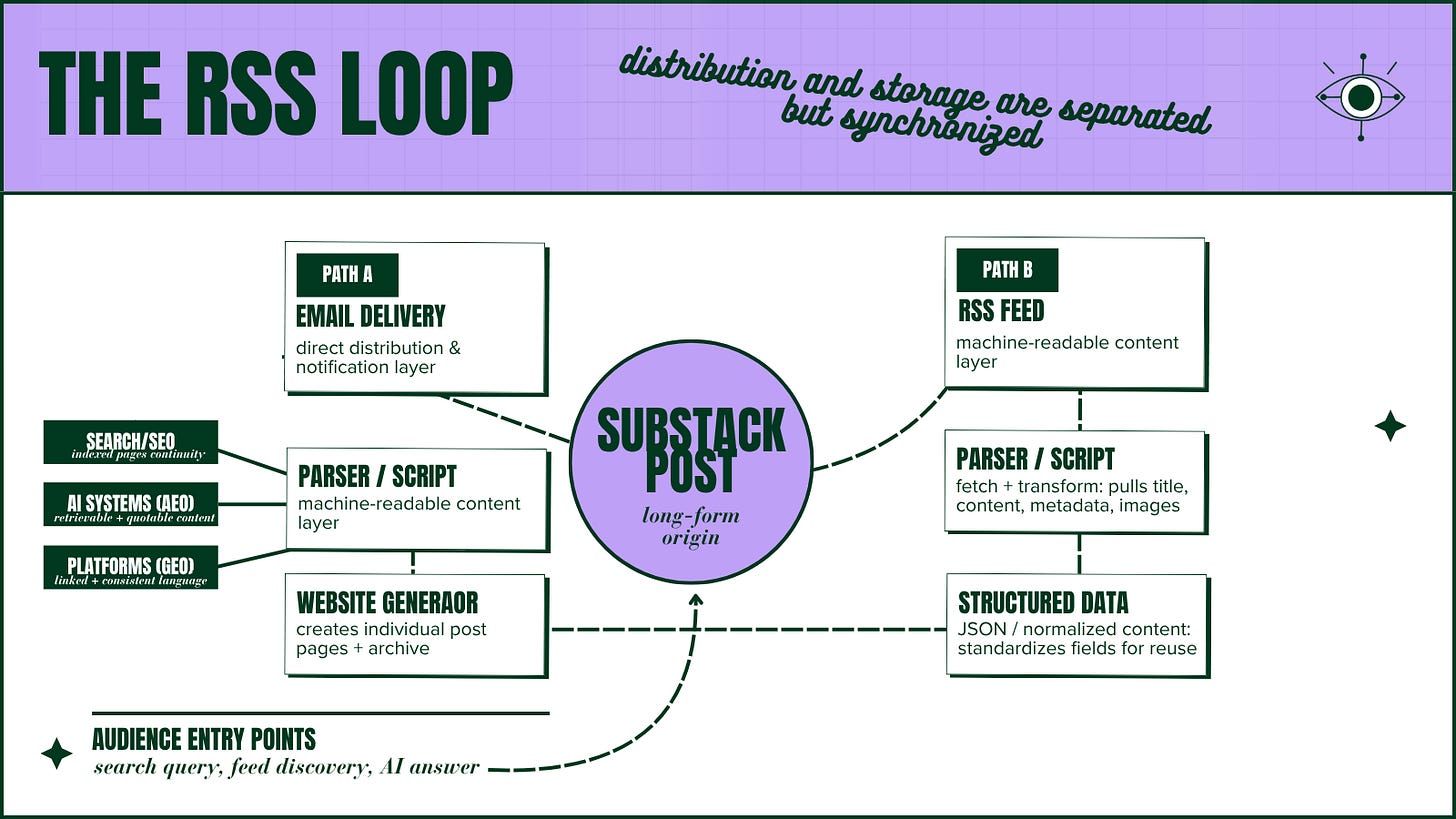
The same script generates full HTML pages for each post and updates the archive, which allows every piece of writing to exist as a standalone page with its own structure, metadata, and internal links rather than being embedded inside another platform’s frame.
A second script runs after generation and standardizes every page, enforcing the same navigation, layout, and component structure across the site, which removes the need to manually correct formatting and ensures that every post contributes to a consistent system instead of introducing variation.
Once that pipeline was working locally, I connected it to GitHub Actions so the system runs continuously, checking the feed, rebuilding content, regenerating pages, and only committing changes when something new appears, which removes the publishing step entirely and replaces it with an ongoing process.
For climate, clean energy, and advocacy organizations, this creates a way to compete in a landscape where you can’t outspend on production or ads, because the advantage shifts toward clarity, consistency, and systems that let your content travel further than a single post ever could. This kind of system renews limited resources, because teams can repurpose long-form content into multiple formats that all point back to a single structured source, which reduces production strain while increasing distribution reach across systems that would otherwise require separate inputs. Substack continues to function as a free email distribution layer within this system, allowing you to keep audiences up to date while the rest of the infrastructure handles indexing, retrieval, and cross-platform distribution.
02Why Long-Form Content Functions Differently Now
RSS is resurfacing because of how platforms and search systems interpret content, where increased production volume has made isolated posts harder to distribute while structured, consistent language becomes easier to classify and surface.
Across platforms, content supply has expanded faster than attention, which means systems rely more heavily on repeated signals and semantic clarity to determine what should be shown, and in that environment a single post functions as a weak signal while a connected body of work creates a pattern the system can recognize.
Long-form content introduces the structure required for that recognition, because it contains enough context, terminology, and internal relationships for systems to understand what the work is about and how it connects to other ideas, which allows it to be indexed, retrieved, and resurfaced over time. This becomes especially relevant in environments where short-form production has scaled rapidly, compressing attention and tightening exposure thresholds, which means content that holds attention and provides clarity gains an advantage over content that competes only on volume. This reduces reliance on any single platform’s distribution model, which can shift unpredictably, and replaces it with a system where content continues to circulate through multiple channels even as individual platform performance fluctuates.
RSS becomes useful again in this environment because it provides a direct, structured way to move long-form content into systems that can index, retrieve, and connect it, which is what the next section breaks down through SEO, AEO, and GEO as layers of the same distribution system.
SEO: Indexing and Continuity
Search engine optimization (SEO) operates at the level of structure, where pages are indexed, linked, and ranked based on how clearly they define topics and how consistently those topics appear across a site.
By moving Substack content into a structured website, each post becomes part of an indexed system where internal links reinforce relationships between ideas and repeated terminology strengthens topical authority over time.
This creates continuity, where search engines can map not just individual posts but the connections between them, which increases the likelihood that the work appears when someone searches for related concepts.
For climate, clean energy, and advocacy organizations, this allows long-form content to function as a repository of knowledge that continues to attract attention beyond initial publication, especially when language aligns with how people search for information tied to lived experience, policy impacts, or local conditions, which strengthens discoverability across both traditional search and emerging hybrid search environments.
The key shift is that SEO is no longer limited to optimizing individual pages, it becomes a function of how well the entire system holds together.
AEO: Retrieval and Synthesis
Answer engine optimization (AEO) emerges from how AI systems generate responses, where instead of returning a list of links they synthesize answers from a small set of sources that meet specific criteria around clarity, attribution, and structure.
Content that is written in a way that can be summarized, quoted, and connected to a defined topic is more likely to be included in those responses, which means long-form writing with clear terminology and consistent framing becomes easier for AI systems to retrieve and use.
This is already visible in how platforms prioritize content that can be transcribed, indexed, and understood across multiple layers, where captions, transcripts, and structured text feed directly into classification systems that determine visibility .
For climate, clean energy, and advocacy organizations, this creates an opening to shape how complex topics are explained at scale, because content that clearly translates policy, infrastructure, or environmental systems into understandable language is more likely to be surfaced in AI-generated answers, which extends reach beyond existing audiences into moments where people are actively seeking understanding.
AEO shifts the goal from ranking to inclusion, where the question becomes whether your content can be pulled into an answer rather than simply clicked as a result.
GEO: Cross-System Language
Generative engine optimization (GEO) extends this further into how language travels across systems, where the same terms appear in your website, your social content, your transcripts, and your newsletters, creating a consistent signal that can be recognized across environments.
When language aligns across these surfaces, systems are able to connect them, which increases the likelihood that your work is associated with specific topics and retrieved in multiple contexts, from search queries to AI responses to platform recommendations.
This becomes increasingly important as platforms layer additional signals such as geographic relevance into ranking systems, where content can be surfaced based on both topic and location, which means language that connects to place, community, and lived experience gains additional distribution pathways .
For climate, clean energy, and advocacy organizations, this allows messaging to operate at multiple levels simultaneously, where national narratives can coexist with local relevance, and where consistent terminology across platforms strengthens both discoverability and trust.
The result is not just visibility in one place, but coherence across the entire ecosystem.
03Content in Context
This means that content strategy is becoming infrastructure design, where the question is no longer how often to publish or which platform to prioritize, but how to build systems that allow language to persist, connect, and be retrieved across environments.
For climate, clean energy, and advocacy organizations, this shift is directly tied to participation, because the ability to locate, understand, and act on information depends on whether that information is accessible across the systems people actually use, from search to social to AI interfaces and direct audience channels like email.
Long-form content becomes the layer that holds meaning, where complex topics like energy systems, policy mechanisms, and community impacts can be explained with enough depth to support understanding, while shorter formats and newsletters act as entry points that guide people into that deeper layer and keep them connected over time.
This matters in a resource-constrained environment, where many organizations cannot compete with corporate production budgets or paid distribution, because a connected system allows one piece of long-form content to generate multiple points of entry, extend its reach, and maintain ongoing audience relationships without requiring proportional increases in output.
The broader implication is that access begins to follow structure, where organizations that build systems capable of carrying their language across platforms, search, and subscription channels create more opportunities for people to encounter and stay connected to their work, while fragmented systems continue to rely on moments of visibility that dissipate quickly.
Taken together, each piece of content from output to infrastructure, contributes to a system that supports recognition. Recognition, sustained through retrieval and direct audience connection, becomes the condition that allows participation to happen at scale.