Instead of typing a few keywords into Google and scrolling through links, you’re more likely to ask a full question and expect a complete answer.
You might paste a paragraph into ChatGPT and ask for clarity.
You might ask a tool to explain something of opening five tabs and piecing it together yourself.
That shift is structural. And has consequences for how information is found, trusted, and shared online.
For years, discovery on the internet was shaped by search engines and keywords. Today, it is increasingly shaped by conversational systems that summarize, select, and present answers directly. Understanding that change matters, especially for nonprofits and mission-driven organizations that rely on visibility to do their work.
01From Keyword Search to Conversational Discovery
For a long time, search behavior was transactional. People typed short phrases like “food pantry near me” or “climate change statistics” and scanned a list of links. Websites were built to capture that behavior. Content was optimized around keywords, metadata, and ranking position.
Research from Backlinko shows that most traditional search queries contain three words or fewer. That reflected both how people searched and how search engines returned results.
Generative AI has shifted that behavior. People now ask questions the way they speak. They expect an answer that feels complete. Harvard Business Review reports that 65 percent of Gen Z adults use AI chatbots as a substitute for traditional search engines. Many of those users have become accustomed to conversational AI as a replacement for search, but lack literacy on AI hallucinations and error rate.
User expectations have changed the user experience. Discovery has become less about navigating links and more about receiving explanations.
02How AI Systems Decide What Gets Seen
Generative systems do not rank pages in the same way search engines do. They select sources they can summarize confidently and combine into a coherent response.
That means content is more likely to surface when it:
Answers a specific question clearly
Is structured in a way machines can parse
Signals credibility through consistency and clarity
Uses language that matches how people actually ask questions
This is why people are starting to describe a shift toward Generative Engine Optimization. The goal is to be useful enough that an AI system can rely on your content when generating an answer.
In practice, this favors content that is explanatory rather than promotional and precise rather than broad.
03Why YouTube Shows Up So Often in AI Answers
One of the quiet but important changes in this shift is the growing role of YouTube.
YouTube videos are highly accessible to AI systems because they come with transcripts, structured metadata, and natural language titles and descriptions. That makes them easy to parse and summarize.
Several industry studies have found that YouTube appears in roughly 30 percent of generative search overviews. It now shows up more often than Reddit as a quoted source in AI-generated answers.
This helps explain why explanatory video content performs so well in modern discovery systems. This plays a huge role in accessibility to machines that are tasked with summarizing the internet.
04Monetization Is Entering the Conversation Layer
Search has been shaped by money, and generative search will be no different.
OpenAI has begun testing ads in the free version of ChatGPT. These appear when user intent suggests a commercial query, and they are placed directly under generated answers. The structure mirrors how Google Ads function, but the placement happens inside the answer flow.
This raises important questions about how visibility will work as these systems scale. Organizations with large budgets will have more options to pay for placement. Others will depend more heavily on consistency, clarity, and trust to remain visible.
For mission-driven organizations, this makes content strategy more consequential. Visibility becomes harder to separate from power.
05What This Means for Nonprofits and Mission-Driven Brands
As discovery shifts toward conversational systems, a few strategic adjustments become especially important.
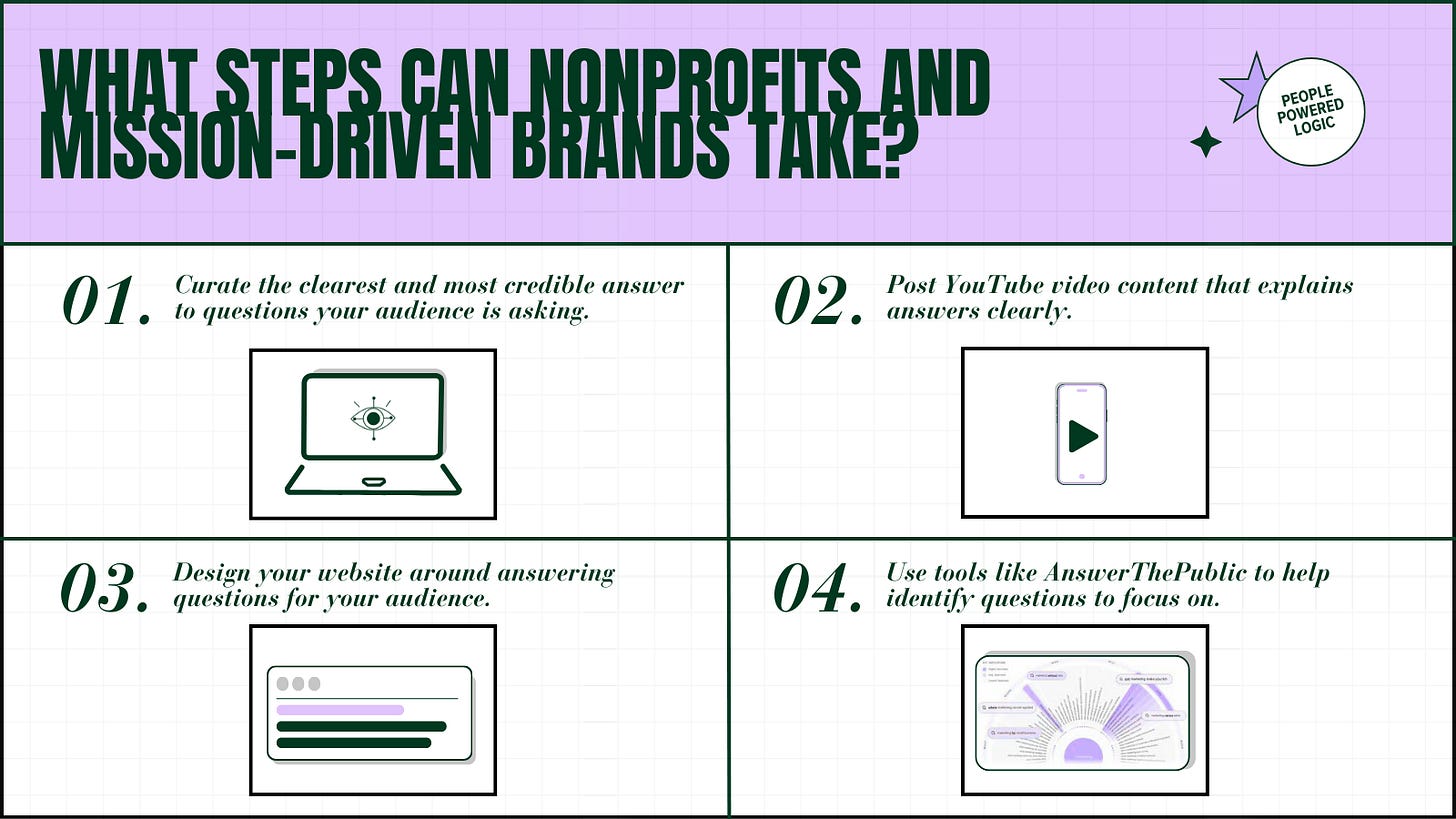
First, content needs to be designed around real questions. This means understanding what your audience is trying to learn. Tools like AnswerThePublic, Google’s “People Also Ask,” and direct community feedback can help surface those questions.
Second, video matters more than many teams expect. YouTube is a major knowledge source for AI systems. Clear, explanatory videos increase the chances that your work is referenced and shared through generative tools.
Third, websites should prioritize clarity over volume. Pages that answer one question well are more valuable than pages that try to cover everything. Clear headings, concise summaries, and accessible language help both humans and machines understand your work.
Finally, structure matters. Using FAQs, schema markup, and consistent page formats helps AI systems interpret your content accurately
06Why This Matters
When discovery happens through summaries, someone decides what gets included and what gets left out. That decision is shaped by what is easiest to explain, easiest to trust, and easiest to compress.
This has implications for equity, nuance, and power. Complex work that resists simplification risks being overlooked. Organizations that lack resources to experiment with new formats may struggle to stay visible.
At the same time, this shift rewards clarity, accessibility, and genuine usefulness. It creates space for organizations that are willing to explain their work plainly and meet people where they are.
The way people find information is changing. The question is how intentionally we respond to it.