The hashtag was first proposed on Twitter as a way to group conversations. It spread because it solved a structural problem: how to index topics at scale across millions of users. A post could attach itself to a larger conversation simply by labeling itself.
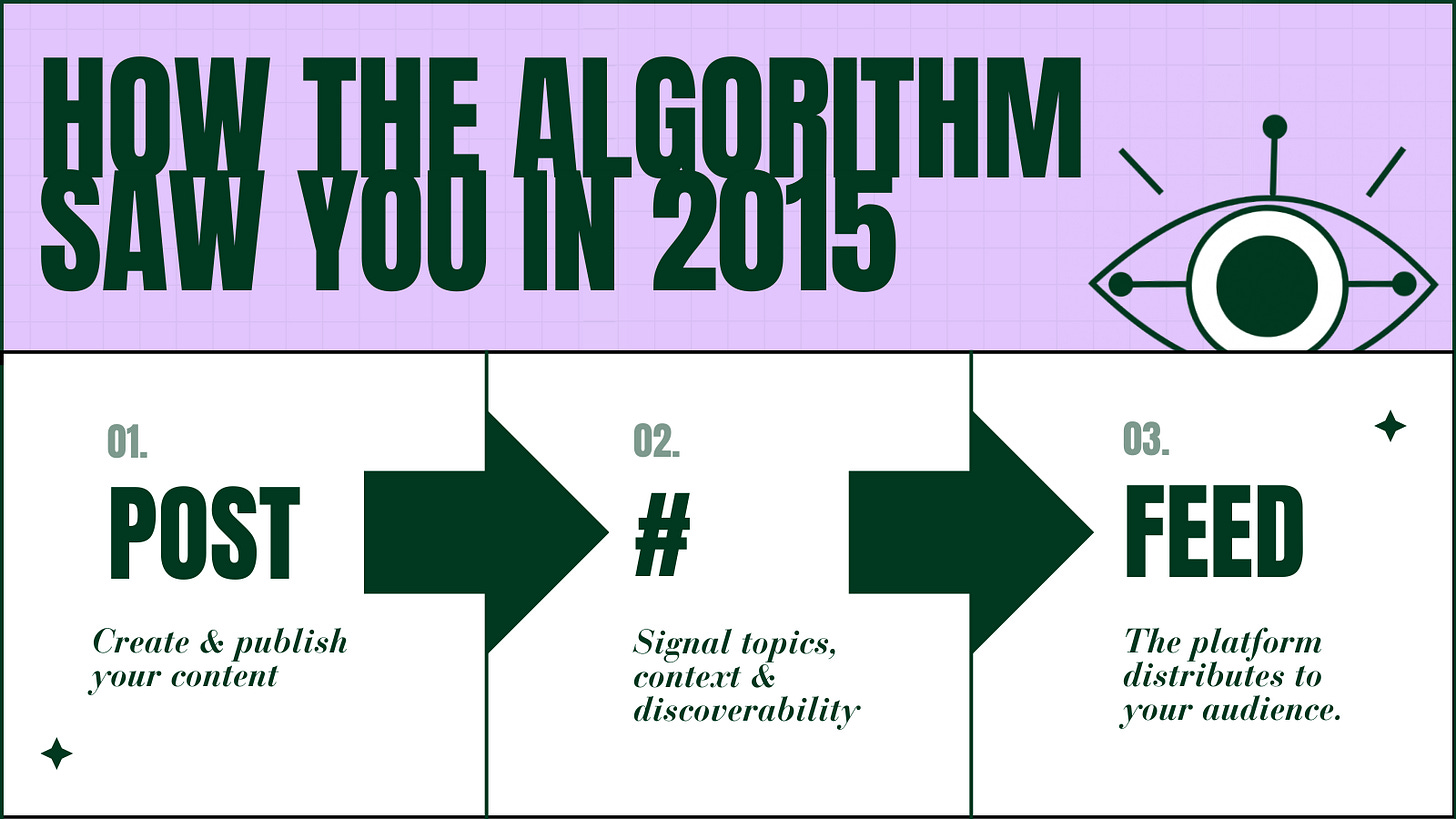
Hashtags were visible metadata. They allowed decentralized discovery. They created searchable clusters across people who did not follow one another. On early Instagram, you could browse chronological hashtag feeds, you could follow hashtags and receive posts outside your immediate network; discovery was topic-led and user-organized.
Hashtags are still present across platforms, but they no longer function as the engine of discovery. The infrastructure beneath them has shifted.
01From User-Labeled Discovery to Machine Classification
Hashtags were once the primary way platforms understood what a post was about.
Today, platforms analyze far more signals than a tag appended to the end of a caption. Natural language processing evaluates the full caption. Computer vision interprets visual elements. Audio recognition parses spoken words. Transcripts are indexed. Watch time and retention are measured at the millisecond level.
Classification now happens at the system layer.
Instead of users organizing the internet through tags, platforms organize content through predictive modeling. Posts are routed based on probability:
who is likely to engage,
who has engaged with similar topics before,
how quickly others respond,
and how long viewers stay.
Hashtags have been absorbed into a larger architecture.
02Instagram
The Quiet Demotion of the Hashtag
Instagram once relied heavily on hashtag feeds for discovery. Creators stacked ten, fifteen, sometimes thirty tags in hopes of expanding reach. Entire strategies were built around “hashtag research.”
Between 2020 and 2024, Instagram transitioned fully into recommendation-driven feeds. The Explore page, suggested Reels, and For You-style recommendations became primary discovery surfaces.
Public statements from Head of Instagram, Adam Mosseri solidified that hashtags do not meaningfully increase reach on Threads. In late 2025, Instagram capped hashtags at five per post. Although many creators report effective limits closer to three, and the ability to follow hashtags was removed.
Meta framed the change as an effort to reduce spam and emphasize meaningful tags over long lists of generic keywords. Internal testing and creator reporting suggest that posts with zero hashtags and posts with a few targeted hashtags perform similarly when engagement signals are equal.
Instagram now prioritizes:
Predicted interest based on user behavior
Watch time and retention on Reels
Saves and shares
Topic consistency across posts
Clear caption language
Hashtags now act as signals of context rather than engines of reach. They help clarify what a post is about, but Instagram’s classification systems increasingly read the entire caption for meaning. Investing in richer, more intentional caption language often strengthens discoverability more than adding additional tags.
03LinkedIn
Relevance and Early Engagement Velocity
LinkedIn’s feed is structured around predicted relevance. According to LinkedIn Engineering’s blog, “Understanding dwell time to improve LinkedIn feed ranking,” the feed ranking system uses machine learning models to estimate the probability that a member will click, react, comment, or share a post, along with expected downstream and upstream network effects. Those predictions are combined into a weighted score that determines how candidate updates are ordered in the feed.
LinkedIn’s Help Center states that hashtags “improve post visibility” by connecting content to relevant topics and audiences and recommends using three to five hashtags per post for discoverability. Within the platform’s guidance, hashtags function as topical connectors that help classify content inside professional conversations.
At the same time, LinkedIn’s ranking system prioritizes behavioral signals. Posts are evaluated based on how quickly they generate comments, reactions, and meaningful engagement within first-degree networks. LinkedIn’s Engineering blog explains that LinkedIn introduced dwell time modeling and a “P(skip)” model to reduce the visibility of updates that members quickly scroll past. Visibility expands when early response patterns indicate relevance and value.
Within platform guidance, hashtags function as topical connectors that help categorize content. But feed ranking itself is governed by behavioral prediction. On LinkedIn, visibility is primarily shaped by:
Relevance to your first-degree network
Early comment velocity
Predicted engagement probability
Dwell time and skip likelihood
Historic interaction patterns
Hashtags support contextual categorization within the visible layer of the platform. Distribution is determined more heavily by engagement signals and relevance modeling within LinkedIn’s ranking infrastructure.
04TikTok
Retention Over Tagging
TikTok popularized trend-based tagging. Hashtags once acted as entry points into challenges and viral formats.
Today, TikTok recommends using up to five hashtags per post, but distribution is not unlocked at the tagging layer. The platform reads full captions, spoken words, on-screen text, and behavioral signals to determine who should see a video. A longer caption within TikTok’s 2,200-character limit allows for clearer keyword signaling than five appended hashtags alone. Using five to ten intentional keywords that you already deploy across your website, newsletters, and other platforms creates stronger semantic consistency than stacking trending tags.
The primary driver of reach is retention. Platform data consistently shows that:
Completion rate strongly influences distribution
Average watch time relative to video length predicts scale
Early engagement velocity increases likelihood of broader testing
Research on TikTok performance shows that many viral videos fall under thirty seconds. Although the average video length is longer, viewer drop-off happens quickly, making early retention critical. TikTok’s distribution model favors content that sustains attention, with completion rate and watch time carrying more structural weight than hashtags. Tags can support context, but clarity, retention, and behavioral response determine scale.
05YouTube and the Long Arc of Search
On YouTube, hashtags have always been secondary to metadata, transcripts, and watch time. The platform was built as a searchable video archive long before vertical short-form accelerated distribution.
YouTube Shorts has generated over 70 billion views per day since 2024. Yet YouTube’s recommendation and search systems remain deeply influenced by long-form watch time, session duration, subscriber behavior, and topical consistency across a channel’s library.
Unlike feed-only platforms, YouTube operates on two layers simultaneously: recommendation and search. Its infrastructure parses titles, descriptions, transcripts, and viewer behavior to understand both topic and depth. Videos are indexed not just by tags, but by full spoken language.
Search indexing on YouTube is shaped by:
Title clarity
Description structure
Transcripts
Viewer retention
Session watch time
Hashtags may appear in descriptions, but they function as peripheral markers inside a system that reads full semantic context. Shorts can generate awareness, yet authority compounds through structured long-form content that sustains watch time and signals expertise over time.
06The Broader Pattern
Early social feeds organized conversation through hashtags. Users labeled posts and those labels created visible streams that others could browse. A tag determined where content gathered and how it was surfaced.
As content volume expanded into the billions, tagging alone could not organize attention. Systems began reading full captions, visuals, transcripts, audio, and engagement history to determine distribution. Meaning is now inferred from the entire post and from audience behavior around it.
Reach is shaped by:
Predicted interest modeling
Engagement velocity
Completion and retention
Semantic clarity
Consistency of positioning
Content circulates when models calculate sustained relevance and interaction probability. Hashtags can contribute context, yet distribution is governed by predictive infrastructure.
07What Led Us Here?
Hashtag-led discovery worked when feeds were chronological and networks were smaller. The hashtag functioned as a visible organizing layer. It created topic clusters that anyone could enter. It helped build the early architecture of social discovery by allowing users to label and group content at scale.
As platforms expanded to billions of users and trillions of posts, manual clustering became inefficient. Recommendation systems began operating beneath that visible layer, interpreting full captions, images, audio, and behavioral signals to determine how content should move. Distribution shifted from user-labeled grouping to predictive modeling. Classification moved into the foundation of the system.
Large Language Models accelerated this shift while also preserving an older pattern. Many generative tools were trained on versions of the internet where hashtags were treated as meaningful levers for reach. That training data still shapes how AI drafts social posts. As a result, automated content frequently includes long strings of generic or loosely related tags. The formatting reflects a previous growth strategy that no longer governs distribution.
This is how inflation entered the tagging layer. The volume of hashtags has increased while their structural influence has declined. The visible artifact remains, but the foundation that determines reach now operates elsewhere.
Hashtags helped build the architecture of early social media. The systems governing distribution today rest on different foundations, where language clarity and behavioral signals carry more weight than appended labels.
08What This Means for Creators and Organizations
Hashtags do not meaningfully increase reach in 2026. Across major platforms, distribution is governed by predictive modeling, retention thresholds, engagement velocity, and semantic interpretation. Public statements from Instagram leadership confirm that hashtags do not significantly expand reach. LinkedIn positions them as topical labels. TikTok and YouTube prioritize watch time, completion rate, and audience response patterns. Platform behavior reflects this consistently.
A few relevant tags can clarify context. Large stacks of generic hashtags add visible volume without structural leverage because classification happens beneath the surface of the caption.
The levers that influence distribution now sit in the foundation of the system:
Clear positioning inside captions
Consistent topic architecture across posts
Early engagement from a defined audience
Retention and watch time
Language structured clearly enough for systems to interpret
Hashtags do have some visibility, but distribution is determined deeper in the infrastructure.
09What Do Hashtags Symbolize Today?
As AI-assisted publishing has expanded, one of its most recognizable surface patterns is the dense hashtag block at the end of a caption. The formatting often appears standardized. The tag clusters repeat across industries. The categories are broad enough to apply almost anywhere. Over time, that repetition changes how the formatting is perceived.
Audiences are developing pattern recognition. Heavy hashtag use increasingly reads as templated production rather than authored voice.
My hot take is this: in 2026, excessive hashtag stacking has become a visual marker of AI-generated content. It signals optimization layered onto messaging. It suggests automation before expertise. Brands that continue to rely on visible stacks of tags risk gradual erosion of audience trust, not because hashtags are inherently flawed, but because the formatting now resembles machine output more than human fluency.
Trust consolidates around clarity and voice. Around language that stands on its own without visible padding.
Hashtags helped build an earlier layer of the social web. Today’s infrastructure operates elsewhere, and audiences can feel that shift. The question is not how many hashtags to add. The question is whether your language carries enough structural integrity to travel without them.