Amongst the stars, orbit forms around mass to pull surrounding bodies inward. Social networks also have a gravitational force consolidating attention around creators whose knowledge accumulates enough informational mass to repeatedly pull audiences back toward the same source.
Feeds no longer distribute visibility primarily through follower accumulation because platforms now evaluate whether content sustains retention, generates interaction, maintains topical coherence, and produces measurable downstream behavior. The expert influencer is someone who repeatedly translates specialized knowledge into formats platforms can distribute and audiences can immediately use. Knowledge strengthens gravitational pull.
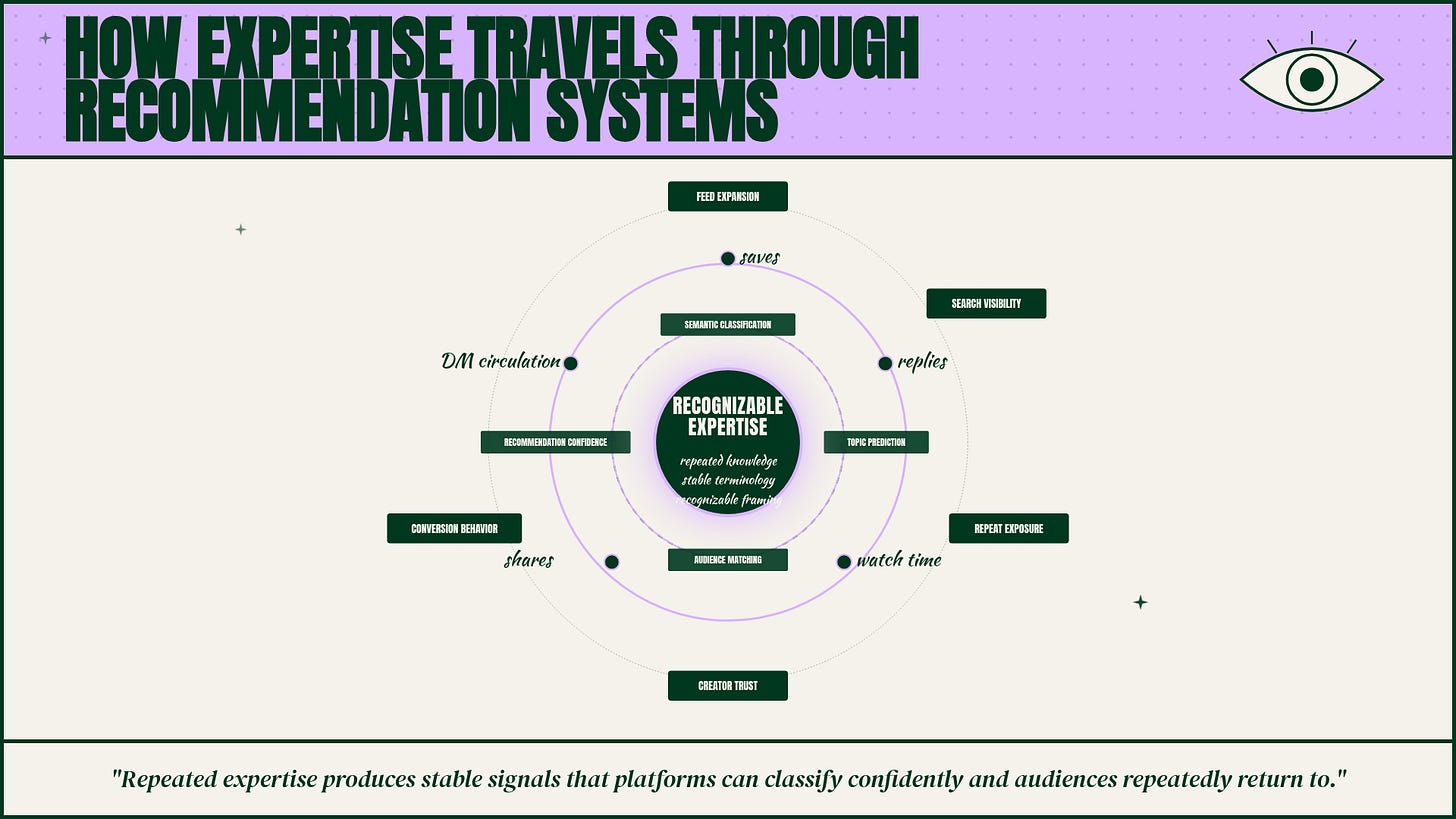
Instagram’s 2026 platform guidance centers views, watch time, retention, originality, and private sharing as core visibility signals while explicitly confirming that DMs have become one of the primary environments for content circulation. TikTok continues routing discovery through behavioral interest systems instead of follower relationships, allowing highly legible knowledge to rapidly reach qualified audiences. LinkedIn’s 2026 feed upgrades built around generative AI and LLM-enhanced recommendations strengthen the platform’s ability to interpret what content means, raising the reach and engagement of creators whose knowledge remains coherent across content.
Linqia’s 2026 survey found that 81% of marketers believe creator content outperforms brand-created assets, 100% now repurpose creator content beyond creator-owned social channels, and 64% reuse creator content across websites, landing pages, or product pages. CreatorIQ also found creator content mentioning brands reached volumes 32 times larger than what leading brands produced on owned channels alone, while 98% of brands now repurpose creator content across websites, paid media, email, events, and internal campaigns.
These conditions reward creators whose knowledge can be recognized quickly and trusted repeatedly. The pattern extends across platforms where recommendation systems favor content that can be confidently classified, behaviorally routed, and attached to measurable outcomes. The emerging “expert influencer” therefore derives gravity from authority and recognizable competence. Formats that consistently translate complexity into native platform formats pull audiences inward and keep attention because they are useful.
01The creator economy is infrastructure
Long-term creator relationships are foundational as platforms reward topic ownership and recognizable authority over time. CreatorIQ found creator marketing now strengthens performance across paid advertising, owned social, content marketing, ecommerce, and search simultaneously, reinforcing how creator ecosystems increasingly function as operational infrastructure rather than campaign add-ons. Linqia’s 2026 State of Influencer Marketing report found that 74% of marketers now use long-term creator partnerships and ambassador relationships, reflecting how brands build trust with audiences by working with creators over time.
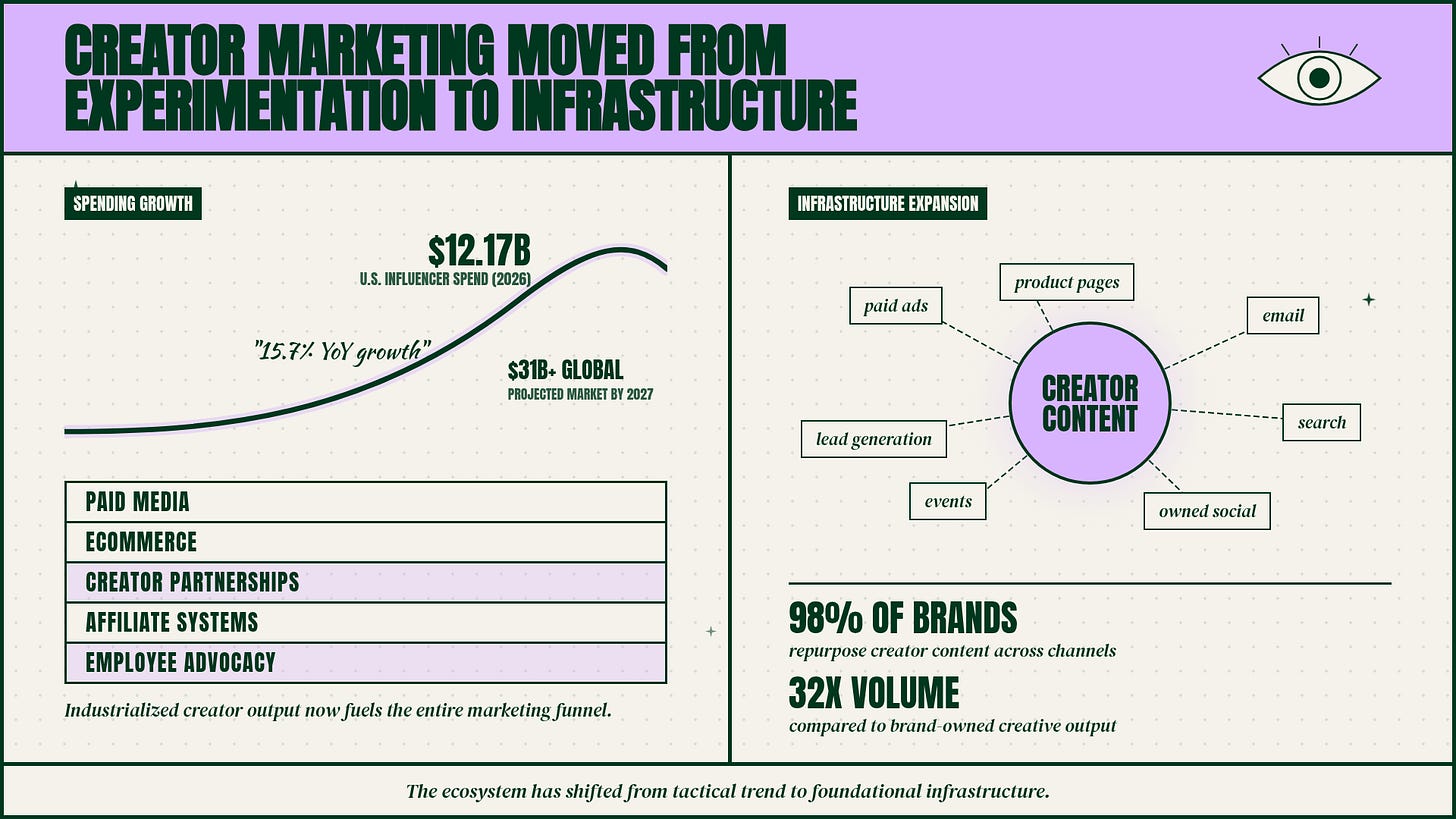
HypeAuditor describes 2026 as the point where influencer marketing moves from “growth and experimentation to disciplined, data-driven influencer marketing built for long-term performance,” while Aspire reports that 74% of marketers plan to increase influencer budgets despite broader economic pressure. Linqia found that 62% of marketers increased influencer budgets year over year and that 33% now plan to spend over $5 million annually on influencer programs. Aspire projects influencer marketing spend in the United States reaching $12.17 billion in 2026 with 15.7% year-over-year growth, while HypeAuditor projects the broader global influencer economy surpassing $31 billion by 2027. Creator ecosystems now sit inside measurable business infrastructure connected directly to paid media, ecommerce, lead generation, and conversion systems.
Climate and clean energy organizations are entering this environment at the same moment public understanding increasingly depends on translation: explaining permitting, electrification, grid infrastructure, policy, workforce transitions, tax credits, and consumer adoption through formats people already encounter inside feeds. That pulls toward creators capable of sustaining coherent expertise across months or years rather than isolated sponsorship cycles.
02Knowledge over everything
The strongest gravity pulls toward creators who repeatedly solve the same class of problem for the same class of audience. Recommendation systems reward consistency because repeated terminology, recognizable framing, and stable topic ownership make content easier to build trust across feeds. Audiences reward the same behavior because knowledge reduces friction during information overload. A creator explaining solar permitting, climate policy, EV charging, tax credits, heat pumps, or grid infrastructure every week builds stronger behavioral trust than a general lifestyle account occasionally touching the topic. Over time that repeated usefulness strengthens saves, replies, shares, consultations, applications, affiliate purchases, and private DM circulation, which gives platforms clearer evidence that audiences find the content useful enough to return to repeatedly.
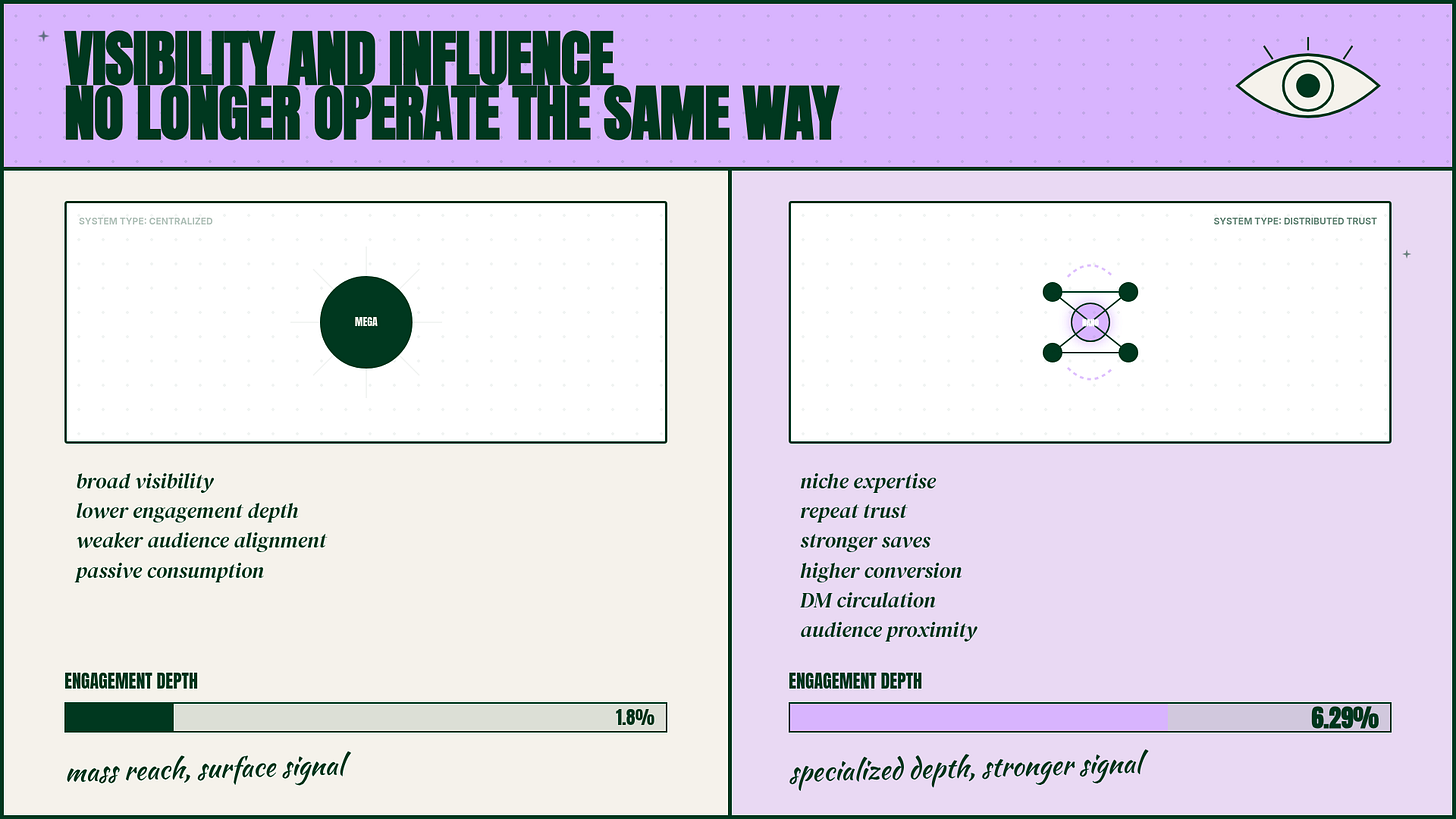
This is one reason micro and nano creators now sit near the center of influencer strategy. Aspire’s 2026 benchmark data shows nano creators averaging 6.29% engagement rates compared with 1.8% for mega creators, while 54% of marketers now primarily work with nano and micro influencers.
HypeAuditor reports that over 80% of Instagram creators now fall into nano tiers with fewer than 10,000 followers, reinforcing how the creator economy increasingly operates through tightly aligned niche communities rather than mass celebrity alone. Their research also found nano influencers producing the highest engagement rates across TikTok and Instagram because smaller communities create stronger audience proximity and higher interaction depth. EMARKETER projects micro and nano creators approaching nearly half of influencer marketing spend by 2026, reflecting how marketers increasingly evaluate creators through conversion efficiency rather than raw audience size.
Follower accumulation and behavioral influence now operate as separate systems: large audiences generate visibility, while aligned expertise generates action.
03Algorithms Reward Human Knowledge
Recommendation systems now depend on semantic alongside behavioral prediction, which raises the value of content that can be clearly understood, categorized, and routed toward the right audience. Educational and explanatory creators benefit from this environment because consistent knowledge reduces ambiguity for both algorithms and viewers.
TikTok elevated “Educators” and “Originators” inside its 2026 Discover List, strengthening the platform’s role as a recommendation-driven discovery engine where knowledge reaches qualified audiences efficiently. YouTube occupies a parallel role through durable search visibility and long-term intent-based discovery. Aspire’s 2026 benchmark report found YouTube generating 23.16% engagement rates compared with 4.8% on TikTok and 2.15% on Instagram, reinforcing how audiences often engage more deeply when they enter platforms with explicit informational intent.
Short-form video became the interface layer carrying this expertise across feeds because it compresses explanation, demonstration, personality, and trust signals into formats platforms can rapidly test against behavioral cohorts. Linqia’s 2026 survey found that 100% of marketers now use short-form video in creator partnerships while Instagram expanded longer Reels and continued recommendation support for narrative-driven content.
HypeAuditor also notes that platforms increasingly support educational and story-driven formats rather than ultra-short novelty alone, particularly as recommendation systems optimize around watch time and return attention. Creator workflows simultaneously became easier to sustain because AI-assisted tools now support scripting, ideation, optimization, editing, and content planning at scale. Aspire reports that 59% of marketers already use AI across influencer workflows, while HypeAuditor found that 89% still do not plan to work with AI-generated influencer clones, reinforcing that platforms continue valuing recognizable human expertise even as production infrastructure becomes automated.
This environment expands who qualifies as an “expert influencer.” The category no longer belongs only to doctors, founders, or consultants because feeds now reward any creator capable of repeatedly translating specialized knowledge into recognizable platform-native formats.
You can see this structure across emerging creator ecosystems already.
documents the process of building products publicly through recurring technical explanations and iterative app development.
@pikacodes translates programming workflows into approachable short-form educational content built around repeatable technical framing as a software engineer.
@understandingurbanism turns urban planning and transit systems into visually legible public interpretation.
@ayeeeitscamila combines aerospace engineering expertise with creator-native communication formats that make technical careers socially accessible.
wina_janaina translates international law and United Nations policy into recurring educational commentary.
Their content accumulates trust because audiences repeatedly encounter demonstrated competence inside familiar feed environments, and over time that content transforms expertise into a recognizable social signal. Across each example, influence comes from niche specificity, repeated framing, audience intent alignment, and sustained knowledge translation that audiences trust and converts into action.
Climate and clean energy organizations are entering this environment at the same moment public understanding increasingly depends on translation: explaining permitting, electrification, grid infrastructure, policy, workforce transitions, tax credits, and consumer adoption through formats people already encounter inside feeds. That creates space for a new generation of climate expert influencers whose authority comes from making complex infrastructure socially legible across feed
04Employee advocacy is the same system
The rise of the expert influencer extends directly into employee advocacy because professional knowledge now travels through the same feed-native systems shaping creator visibility everywhere else online. LinkedIn already frames employee advocacy and Thought Leader Ads around trusted individual voices rather than faceless institutional messaging, reinforcing how authority increasingly accumulates through recognizable people repeatedly explaining the work in public.
This also explains why long-term microinfluencer relationships are becoming essential across climate communication. Smaller creators often maintain tighter audience alignment around specific problems, industries, technologies, or communities, which produces stronger trust and clearer downstream behavior over time. A creator consistently explaining heat pumps, transmission buildout, battery storage, public transit, green jobs, or climate policy to a highly aligned audience may generate stronger applications, consultations, donations, partnerships, or purchasing behavior than a much larger general-interest account. Recommendation systems reward repeated topic ownership because stable expertise strengthens classification confidence and sustained interaction patterns. Long-term creator partnerships therefore function less as temporary sponsorship arrangements and more as distributed trust infrastructure threaded through search, recommendation systems, and community participation simultaneously.
Audiences have begun to challenge assumptions about what social media should be for. These expert influencers push against conventions built around passive scrolling, disposable entertainment, algorithmic clutter, and AI-generated sameness by using attention to teach, explain, organize, and expand participation. I originally entered social media from a teaching background because I wanted to experiment with new ways of helping people retain and apply knowledge across digital environments where attention already existed. That same pattern now appears across creator ecosystems where engineers teach infrastructure, planners explain cities, climate communicators interpret policy, and technical workers translate specialized systems into something people can actually use in everyday decisions. The social web is reorganizing around trust. AI-assisted recommendation systems, creator-led commerce, semantic classification, and performance-based marketing all reward creators who reduce uncertainty by translating complexity into recognizable formats audiences repeatedly return to. The creator economy still contains celebrity visibility and entertainment culture, but its center of gravity is pulling toward people capable of making specialized knowledge understandable enough for platforms to classify confidently and for audiences to use in everyday decisions.
For climate and clean energy organizations, this turns employee advocacy into strategic communication infrastructure because engineers, analysts, researchers, organizers, and technical workers increasingly function as the interpreters helping audiences understand how large-scale transitions connect to everyday decisions and public participation. Organizations need experts capable of turning complex systems into socially legible knowledge audiences can encounter repeatedly across feeds.